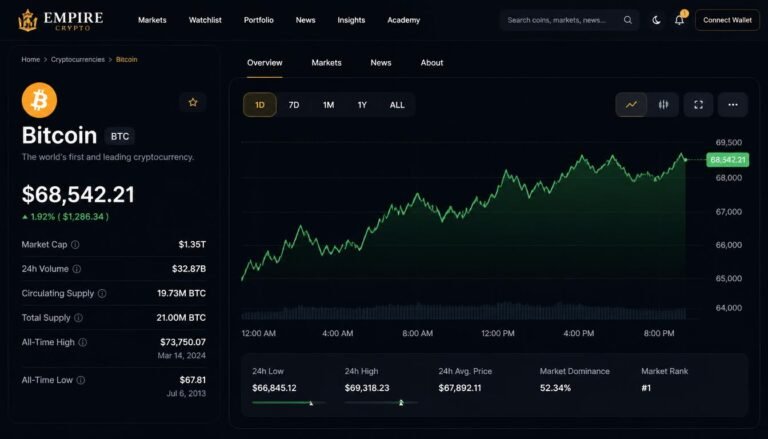
By grounding your education in cold, objective data, you can look past market hype and accurately evaluate network health, tokenomics, and decentralized protocol performance. This comprehensive guide highlights the absolute best online Crypto Data Online sites for building deep blockchain knowledge, categorizing them by use case and detailing exactly how to use them.

1. Structural Financial Analytics: Token Terminal
If you want to view the crypto market through the lens of traditional fundamental financial analysis, Token Terminal is an indispensable resource. It aggregates complex, raw smart-contract data and translates it into standardized financial metrics. This approach treats decentralized protocols like public companies, generating clear income statements, balance sheets, and cash flow equivalents.
[ Raw Ledger Events ] ➔ [ Ingestion & Parsing ] ➔ [ Standardized Metrics ]
                                                          │
                             ┌────────────────────────────┴────────────────────────────┐
                             ▼                                                         ▼
               [ Financial Statements ]                                   [ Valuation Ratios ]
             (Fees, Revenue, Token Incentives)                                (P/F Ratio, P/S Ratio)
Essential Learning Metrics
- Total Revenue vs. Protocol Revenue: Token Terminal clearly distinguishes between the total fees paid by users and the actual revenue kept by the protocol or distributed back to token holders (stakers). This helps you assess whether a project is sustainable or relying on inflationary mechanisms.
- Price-to-Fees (P/F) Ratio: Calculated as $\frac{\text{Fully Diluted Market Cap}}{\text{Annualized Total Fees}}$. Similar to a traditional Price-to-Earnings (P/E) ratio, a lower P/F ratio indicates that a protocol is generating substantial real economic activity relative to its speculative market value.
- Token Incentives: This measures the value of native tokens distributed to users as rewards. Comparing token incentives against protocol revenue reveals whether a protocol has real product-market fit or is artificially inflating its usage metrics through expensive emissions.
2. Open-Source Community Tooling: Dune Analytics
For analysts who prefer a hands-on approach, Dune Analytics is a revolutionary platform. It acts as a massive collaborative data warehouse, transforming raw blockchain bytecode into accessible, clean SQL databases.
The beauty of Dune lies in its community-first model. While advanced users can write their own database queries, beginners and intermediate learners can freely search through thousands of public, community-maintained dashboards tracking everything from layer-2 rollup activity to specific NFT marketplace metrics.
Practical Learning Framework Crypto Data Online
If you are learning how to build and read queries on Dune, you will interact with direct database event structures. For example, a student tracking how much stablecoin liquidity is transferring across networks might view an erc20_ethereum.evt_Transfer log. A simple query on the backend looks like this:
SQL
SELECT
    block_time,
    value / 1e6 AS usdc_amount,
    "from" AS sender,
    "to" AS receiver
FROM erc20_ethereum.evt_Transfer
WHERE contract_address = 0xa0b86991c6218b36c1d19d4a2e9eb0ce3606eb48
ORDER BY block_time DESC
LIMIT 50;
Learning Takeaway: Seeing this data visualized in a chart shows you exactly how liquidity moves. Instead of guessing which protocols are being used, you can clearly track active daily addresses, transaction volumes, and user retention curves over time. Crypto Data Online

3. Macro On-Chain Market Signals: Glassnode & CryptoQuant
When studying the structural market mechanics of large layer-1 networks like Bitcoin and Ethereum, Glassnode and Crypto Quant are the absolute gold standards. These platforms focus heavily on macro market signals, market liquidity distribution, and whale behavior.
Critical Educational Dashboards Crypto Data Online
- Exchange Inflow/Outflow Volume: Tracks the net volume of assets moving into or out of centralized exchanges. Large inflows of Bitcoin to an exchange often signal upcoming market liquidations and selling pressure, while net outflows to private cold wallets indicate strong, long-term accumulation.
- Net Unrealized Profit/Loss (NUPL): This is calculated as $\frac{\text{Market Cap} – \text{Realized Cap}}{\text{Market Cap}}$, and it measures the overall paper wealth of the network. Exploring the NUPL chart helps you identify psychological market extremes—such as capitulation, hope, optimism, and euphoria—based on when the average wallet address is in profit or loss.
- Realized Cap: Unlike traditional market cap, which values all mined coins at the current market price, Realized Cap values each coin based on the price it was last moved on the blockchain. This offers a much more realistic picture of the actual capital invested in the network.
4. Wallet Intelligence & Smart Money Tracking: Nansen AI Crypto Data Online
While macro tools look at whole networks, Nansen AI specializes in granular wallet attribution. The platform has indexed and labeled over 500 million public wallet addresses using advanced algorithmic modeling, helping users identify who is behind specific transactions.
Instead of staring at a meaningless string of characters like 0x9f8..., Nansen applies labels such as “Smart Money” (wallets with a proven track record of profitability), “Whale” (wallets holding immense capital), or institutional tags like “Binance Deposit Wallet.”
How to Build Knowledge with Nansen
- Trace Token Flows: By studying the “Token God Mode” dashboard, you can see if institutional venture funds are quietly depositing assets onto exchanges to sell, or if “Smart Money” addresses are accumulating a token during a market downturn.
- Analyze Early Adoption: Tracking wallet labels allows you to spot where highly active, experienced Web3 users are deploying capital first. This helps you identify emerging trends months before they hit mainstream media.
5. Summary Platform Matrix Crypto Data Online
To help you choose the right platform for your research objectives, here is a comparative overview of these top data sites: Crypto Data Online
| Platform | Analytical Focus | Ideal Use Case | Learning Curve |
| Token Terminal | Protocol Financials | Evaluating dApp revenues, P/F ratios, and protocol income statements. | Easy to Moderate |
| Dune Analytics | Custom SQL Queries | Exploring community dashboards and charting niche on-chain events. | Moderate to Advanced |
| Glassnode | Macro On-Chain Signals | Tracking long-term holding patterns, exchange flows, and network NUPL. | Moderate |
| CryptoQuant | Exchange & Derivative Flow | Tracking real-time liquidity trends, whale alerts, and futures market data. | Moderate |
| Nansen AI | Wallet Attribution | Smart Money tracking, analyzing token distribution, and auditing whale balances. | Easy to Moderate |
6. Comprehensive Research Checklist
When researching a new blockchain ecosystem or application, combine these platforms into a single, systematic framework to perform objective, data-backed due diligence. Crypto Data Online
1.Evaluate Base Network Health:Platforms: Glassnode or CryptoQuant.
Check the native network’s daily active addresses, transaction count, and secure hash rate. Confirm that the layer-1 foundation has stable security and growing organic user adoption.
2.Analyze Protocol Profitability:Platform: Token Terminal.
Look up the specific dApp or smart contract. Review its historical fee generation and token incentives. Ensure the protocol is generating real fee revenue and isn’t entirely propped up by inflationary token rewards.
3.Review Micro-Retention Metrics:Platform: Dune Analytics.
Locate a dedicated community dashboard for the project. Analyze user retention and cohort behavior. Is the application attracting new, recurring daily users, or is the activity coming from a small group of legacy wallets?
4.Audit Wallet Concentrations and Flows:Platform: Nansen AI.
Examine the token’s holder distribution profile. Check if “Smart Money” wallets are accumulating or distributing their tokens. If the top 10 non-exchange addresses own the majority of the supply, note the centralization risk.
7. Crucial Security Principles for Online Data Analysis
As you explore these online analytics portals, keep your data-gathering routine safe by adhering to these essential security rules: Crypto Data Online
- Rely on Public Addresses Only: True on-chain data sites require nothing more than a public wallet address, block hash, or contract identity to run analytics. Never input your private keys or seed phrases into any dashboard or metric site.
- Verify Smart Contract Authenticity: Malicious actors often deploy copycat tokens with identical ticker symbols to trap retail traders. When extracting data from explorers or Dune queries, always verify that the token’s alphanumeric contract address matches the official developer documentation.
- Beware of “Free Alpha” Phishing Ads: Fake copies of analytics platforms frequently purchase sponsored slots at the top of search engine results. Always verify the exact URL structure, and bookmark your primary data sites to avoid accidental phishing traps.
By moving your learning routine away from social media echo chambers and anchoring it in verifiable, public on-chain metrics, you will develop a deeply technical, analytical approach to blockchain technology that is highly competitive in the modern digital economy.