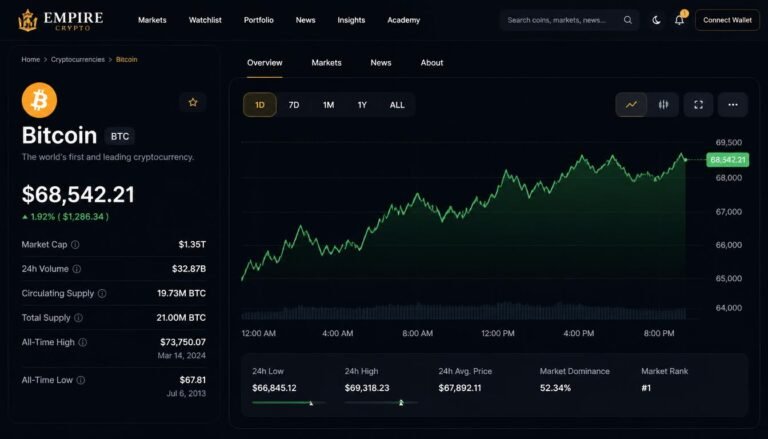
Navigating the digital asset space can feel like learning an entirely new language. Whether you are reading market reports, tracking blockchain transactions, or building a portfolio, encountering confusing jargon is inevitable. Having access to accurate crypto data is essential for making informed decisions. Empire Crypto built this complete crypto glossary to bridge the gap between complex blockchain mechanics and everyday investors.

Why Understanding Crypto Data and Terminology Matters
In digital asset trading, information is power. The cryptocurrency market runs 24/7, generating gigabytes of market data every second.
Without a firm grasp of underlying concepts and clean data crypto solutions, traders often fall prey to market volatility, hype, or bad actors. Leveraging accurate trading data analysis cryptocurrency models enables you to:
- Filter out noise: Differentiate between real technical development and temporary hype.
- Analyze market sentiment: Understand how liquidity, volume, and order books drive token prices.
- Mitigate risk: Evaluate smart contract audits, tokenomics, and wallet behaviors before allocating capital.
- Identify trends early: Recognize sector rotations across DeFi, Layer 2 scaling, and AI-driven Web3 protocols.
About Empire Crypto Data
As a premier crypto data company, Empire Crypto specializes in delivering real-time crypto market data, institutional-grade analytics, and custom data crypto solutions. Navigating decentralized finance requires absolute precision, and cryptocurrency data reliability remains our highest priority.
Whether you need aggregated cryptocurrency market data for enterprise software or clean crypto data analysis for personal trading strategies, Empire Crypto equips you with scalable infrastructure and accurate insights.
Beginner Crypto Terms: The Essentials
Understanding the foundational terminology of digital assets is the first step toward building a successful trading strategy.
1. 51% Attack
An attack on a blockchain network where a single entity controls more than 50% of the network’s mining hash rate or validation power. This control allows the attacker to manipulate transaction order, double-spend coins, and block confirmations.
2. Address (Public Key)
A cryptographic string of alphanumeric characters representing a destination on a blockchain network. Similar to a bank account number, you share your public address to receive digital funds.
3. Altcoin
Any cryptocurrency other than Bitcoin. Prominent altcoins include Ethereum (ETH), Solana (SOL), and Cardano (ADA).
4. Bitcoin (BTC)
The world’s first decentralized digital currency, launched in 2009 by an anonymous creator known as Satoshi Nakamoto. Bitcoin relies on a Proof-of-Work (PoW) consensus mechanism to maintain its public ledger.
5. Blockchain
A decentralized, immutable digital ledger that records transactions across a peer-to-peer network of computers. Each block contains a batch of validated transactions linked to the previous block via cryptographic hashes.
+----------------+      +----------------+      +----------------+
|    Block 1     |      |    Block 2     |      |    Block 3     |
|  (Genesis)     | <--- |  Prev Hash: 01 | <--- |  Prev Hash: 02 |
| Data: Tx Sets  |      | Data: Tx Sets  |      | Data: Tx Sets  |
+----------------+      +----------------+      +----------------+
6. Bull Market / Bear Market
- Bull Market: Extended period of rising prices and positive market sentiment.
- Bear Market: Extended period of falling prices, lower trading volume, and prevailing market pessimism.
7. Centralized Exchange (CEX)
A trading platform operated by a single company or organization (e.g., Binance, Coinbase). CEXs manage order books, hold custody of user funds, and mandate Know Your Customer (KYC) identity verification.
8. Cold Wallet (Cold Storage)
An offline crypto wallet—such as a hardware device or paper wallet—that keeps private keys disconnected from the internet to maximize security against online exploits.
9. Decentrailzed Exchange (DEX)
A peer-to-peer marketplace where users swap cryptocurrencies directly from their self-custody wallets without relying on an intermediary or central authority. Examples include Uniswap and PancakeSwap.
10. Fiat Currency
Government-issued paper money that is not backed by a physical commodity like gold (e.g., USD, EUR, JPY).
11. Gas Fees
Network transaction fees paid to blockchain validators or miners to process actions on a network. On Ethereum, gas fees are paid in ETH.
12. Market Capitalization (Market Cap)
The total market value of a cryptocurrency’s circulating supply. Calculated as:
$$\text{Market Cap} = \text{Current Token Price} \times \text{Circulating Supply}$$
Intermediate Concepts: Trading, Metrics & DeFi
As you gain experience, evaluating assets requires examining technical metrics and understanding decentralized ecosystems. Empire Crypto tracks these data points to help you identify emerging market trends.
| Term | Category | Core Function / Definition |
| AMM | DeFi | Automated Market Maker; replaces traditional order books with liquidity pools to set token prices algorithmically. |
| APY / APR | Finance | APY includes compound interest calculations; APR measures simple interest on annualized yields. |
| Order Book | Trading | A real-time electronic list of buy (bids) and sell (asks) orders organized by price level. |
| Slippage | Execution | The difference between the expected price of a trade and the actual price at which it executes. |
| TVL | Analytics | Total Value Locked; measures the total capital committed to a DeFi protocol’s smart contracts. |
Advanced Metrics Breakdown
Automated Market Maker (AMM)
AMMs rely on mathematical formulas like $x \times y = k$ to price assets dynamically within liquidity pools, eliminating the need for counterparty buyers and sellers.
Liquidity Pools
Crowdsourced pools of cryptocurrencies locked inside a smart contract. They provide the capital required for decentralized trading, yield farming, and lending.
On-Chain vs. Off-Chain Data
- On-Chain Data: Data recorded directly onto a public blockchain (e.g., active wallet addresses, gas spending, transaction fees, smart contract calls).
- Off-Chain Data: External real-world data processed off the main ledger (e.g., order book depth on centralized exchanges, social media sentiment, macroeconomic statistics).
Advanced Architecture: Infrastructure & Data Engineering
Institutional traders and developers analyze deep network metrics to build robust trading models. Empire Crypto provides data infrastructure designed to simplify these complex mechanics.
Consensus Mechanisms
Proof-of-Work (PoW)
A consensus model where computers (miners) compete to solve complex cryptographic puzzles. The first miner to find a valid hash gains the right to add a new block to the chain and claim the block reward.
Proof-of-Stake (PoS)
A consensus mechanism where block validators are selected based on the quantity of native tokens they hold and lock up as collateral (“staking”). PoS consumes significantly less energy than PoW.
Zero-Knowledge Proofs (zk-SNARKs / zk-STARKs)
Cryptographic methods that allow one party (the prover) to prove to another party (the verifier) that a statement is true without revealing any underlying information beyond its validity.
Sharding
A database scaling technique that breaks a blockchain network into smaller, manageable partitions called “shards”. Each shard processes its own transactions and smart contracts, significantly boosting throughput.
The Empire Crypto Glossary: A–Z Complete Reference
Use this index to look up essential crypto terms quickly.
       [A-C] -------------------> [D-F] -------------------> [G-M]
- AirDrop                  - DAO                      - Gas Fees
- Altcoin                  - dApp                     - Hash Rate
- AMM                      - DeFi                     - Layer 1/2
- Blockchain               - DEX                      - Liquidity

       [N-R] -------------------> [S-T] -------------------> [U-Z]
- Node                     - Slippage                 - Volatility
- Oracle                   - Smart Contract           - Yield Farming
- Proof-of-Stake           - Stablecoin               - Zero-Knowledge
A
Airdrop
A distribution method where a project sends free tokens directly to wallet addresses to incentivize user adoption or reward early community members.
Application-Specific Integrated Circuit (ASIC)
Specialized microchips built solely to mine specific cryptocurrencies (such as Bitcoin) at high computational efficiencies.
B
Block Explorer
An online database search tool used to query real-time and historical transaction records, wallet balances, and block data.
Block Reward
The payment given to a miner or validator for successfully verifying a block of transactions and appending it to the blockchain.
C
Collateralized Debt Position (CDP)
A financial structure where crypto assets are locked in a smart contract as collateral to mint decentralized stablecoins or generate loans.
Cross-Chain Bridge
A protocol enabling the transfer of digital tokens and arbitrary data across distinct blockchain ecosystems (e.g., transferring assets from Ethereum to Solana).
D
Decentralized Autonomous Organization (DAO)
An organization governed by smart contract code rather than centralized management. DAO token holders vote on proposals to direct project treasuries and operational changes.
Decentralized Finance (DeFi)
An ecosystem of financial applications built on permissionless smart contracts, offering trading, lending, borrowing, and synthetic assets without traditional financial intermediaries.
E
ERC-20
The technical standard used for implementing fungible tokens on the Ethereum blockchain.
ERC-721
The standard for non-fungible tokens (NFTs) on Ethereum, enabling the creation of unique, non-interchangeable digital assets.
F
Flash Loan
An uncollateralized loan offered by certain DeFi protocols that must be borrowed and fully repaid within the exact same blockchain transaction execution block.
Fully Diluted Valuation (FDV)
The theoretical market capitalization of a project if its maximum token supply were currently in circulation:
$$\text{FDV} = \text{Maximum Supply} \times \text{Current Token Price}$$
G
Gwei
A denomination of the cryptocurrency Ether (ETH), used to measure Ethereum network transaction fees. $1\text{ Gwei} = 10^{-9}\text{ ETH}$ ($0.000000001\text{ ETH}$).
H
Halving (Bitcoin)
A hardcoded event occurring every 210,000 blocks (~4 years) that reduces the Bitcoin block mining reward by 50%, effectively decreasing the issuance rate of new supply.
Hash Rate
The total computational processing power dedicated to mining and securing a Proof-of-Work network per second. Higher hash rates indicate greater network security.
I
Impermanent Loss
The temporary loss of capital experienced by liquidity providers in AMM pools when the relative prices of their deposited token pair diverge compared to simply holding the tokens in a wallet.
L
Layer 1 (L1)
The underlying base blockchain architecture (e.g., Bitcoin, Ethereum, Solana) responsible for consensus, data availability, and final transaction settling.
Layer 2 (L2)
Secondary protocol frameworks built on top of Layer 1 blockchains (e.g., Arbitrum, Optimism, Lightning Network) designed to scale throughput and reduce gas fees by processing transactions off the main chain.
M
Maximal Extractable Value (MEV)
The maximum profit a validator or miner can extract from a block by reordering, inserting, or censoring transactions during block production.
N
Node
A computer connected to a blockchain network that maintains a copy of the ledger, verifies transactions, and enforces protocol consensus rules.
O
Oracle
A secure third-party service that feeds real-world data (such as asset prices, weather data, or sports scores) into blockchain smart contracts.
P
Peer-to-Peer (P2P)
Direct interactions or transactions conducted between two individual users without passing through a centralized intermediary.
R
Real World Assets (RWA)
Tangible or traditional financial assets (such as real estate, government bonds, or commodities) tokenized on a public or private blockchain.
S
Smart Contract
Self-executing digital contracts with the terms of an agreement written directly into code. They automatically enforce and execute actions when predefined conditions are met.
Stablecoin
Cryptocurrencies designed to maintain a stable peg to an external asset, such as a fiat currency (e.g., USDC, USDT) or a commodity like gold.
T
Total Value Locked (TVL)
A key DeFi performance metric representing the total amount of capital currently deposited, staked, or locked within a decentralized application protocol.

Empire Crypto Market Insights: Practical Data Use Cases
Understanding glossary terms is only half the battle—applying them with high-quality data is what improves trading outcomes.
+----------------------------------------------------------------------+
|                     ON-CHAIN ANALYTICS DASHBOARD                     |
+----------------------------------------------------------------------+
|  Asset: ETH/USD              |  Network Gas: 14 Gwei                 |
|  24h Volume: $14.2B          |  Exchange Netflow: -$120M (Outflow)   |
+----------------------------------------------------------------------+
|  Top Indicator Signals:                                              |
|  - Exchange Reserve: Decreasing (Accumulation Phase)                 |
|  - MVRV Ratio: 1.45 (Neutral Valuation)                              |
|  - Active Addresses (24h): 480,000 (+4.2%)                           |
+----------------------------------------------------------------------+
Here is how active market participants use Empire Crypto analytics:
- Spotting Accumulation Trends: When large volumes of crypto move off exchanges into cold wallets, it often signals long-term holding behavior. Empire Crypto tracks these exchange netflows in real time.
- Evaluating Network Health: Spikes in daily active addresses alongside steady transaction volume growth point to organic protocol adoption.
- DeFi Risk Management: Tracking sudden shifts in protocol TVL helps traders spot potential liquidity issues before they affect execution prices.
Frequently Asked Questions (FAQ)
What makes Empire Crypto data solutions unique?
Empire Crypto delivers clean, low-latency market data and on-chain analytics. Our algorithms strip out wash trading and anomalous data points to ensure high data reliability for developers and traders alike.
Why is accurate cryptocurrency data analysis important for beginners?
Relying on low-quality data can lead to execution errors, hidden slippage, and bad entries. Empire Crypto simplifies complex metrics into actionable tools for every skill level.
How often are on-chain metrics updated on Empire Crypto?
Our feeds update continuously, giving users access to sub-second order book updates and real-time block event notifications.
Master the Crypto Markets with Empire Crypto
Navigating the crypto market requires clear insights, accurate terminology, and reliable tools. Empire Crypto gives you the data foundation needed to evaluate projects, track market shifts, and trade with confidence.
Bookmark this complete glossary as your go-to reference guide, explore our real-time analytics suite, and elevate your crypto trading strategy today.