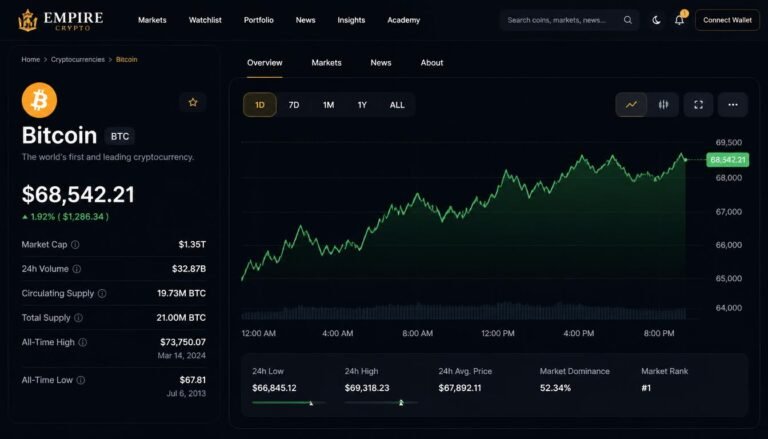
Welcome to Empire Crypto: Essential Guide to Crypto Mining — your ultimate, comprehensive handbook for navigating every layer of the mining economy. In this breakdown, we will demystify the mechanics of Proof of Work (PoW), analyze essential hardware choices, evaluate real-world profitability formulas, and demonstrate how leveraging accurate crypto market data can make the difference between sustained profits and costly operational oversights.

What Is Cryptocurrency Mining?
Cryptocurrency mining is the computational process used to validate transactions on a decentralized blockchain network and issue new digital tokens into circulation.
When users send coins across a Proof of Work network like Bitcoin or Litecoin, those transactions enter a temporary pool known as the memory pool (mempool). Independent computers—known as nodes or miners—collect these transactions, group them into blocks, and compete to solve a complex mathematical puzzle.
The first miner to find a valid cryptographic solution earns the right to append the new block to the public ledger. In exchange for their computational effort and electricity consumption, the winning miner receives two distinct financial rewards:
- The Block Subsidy: Newly minted cryptocurrency created out of thin air by the network protocol.
- Transaction Fees: Small fees paid by users who initiated the transactions contained inside that specific block.
Why Is Mining Essential for Blockchains?
Mining is not just a mechanism for issuing new coins; it is the fundamental security foundation of decentralized networks.
- Preventing Double Spending: Cryptographic puzzles prevent bad actors from spending the exact same digital token twice without consensus.
- Maintaining Decentralization: Thousands of independent mining rigs distributed across the globe eliminate single points of failure.
- Network Security: Modifying past blocks requires controlling more than 51% of the total computing power (hashrate) on the network, which becomes economically unfeasible on major blockchains.
In modern market environments, keeping track of these global network dynamics requires robust cryptocurrency data solutions. Tracking network difficulty, global hashrates, and fee spikes gives operators a massive edge when calculating when to mine and when to adjust hardware configurations.
How Proof of Work (PoW) Works Under the Hood
To succeed in mining, you must understand the underlying cryptographic algorithm that governs the process.
The Cryptographic Hash Function
Blockchains rely on cryptographic hash functions, such as SHA-256 (used by Bitcoin) or Scrypt (used by Litecoin and Dogecoin). A hash function takes any input data (such as block transaction records) and turns it into a fixed-length string of numbers and letters.
Key features of cryptographic hashing:
- One-Way Function: It is mathematically impossible to reverse-engineer the original transaction data from the output hash alone.
- Deterministic Output: The exact same input will always generate the exact same output string.
- Avalanche Effect: Changing even a single letter or character in the input completely alters the resulting hash.
Mining Difficulty and the Nonce
During the mining process, miners do not simply generate any hash. The network sets a target difficulty requirement: the resulting hash must start with a specific number of leading zeros.
Because transaction data inside a block remains static, miners add a random integer called a nonce (“number used once”) to the block header. The mining device rapidly changes the nonce millions or trillions of times per second, rehashing the block header until it stumbles upon a hash that meets or beats the target difficulty requirement.
This brute-force search is why mining demands substantial hardware performance and electrical energy. Analyzing raw crypto data helps miners observe difficulty adjustments, which occur automatically to maintain stable block production intervals.
The Core Types of Crypto Mining Hardware
Choosing the correct hardware is the single most important decision in your mining journey. The hardware you select dictates which cryptocurrencies you can target, your electricity costs, and your long-term return on investment (ROI).
1. ASIC Miners (Application-Specific Integrated Circuits)
ASICs are specialized hardware devices engineered exclusively to compute a single cryptographic algorithm. Unlike personal computers, ASICs cannot run operating systems, execute spreadsheets, or render digital graphics. Their sole purpose is rapid hashing.
- Pros: Unmatched speed (measured in Terahashes per second, TH/s) and maximum energy efficiency for target algorithms.
- Cons: High capital cost, substantial heat output, loud operation noise (often exceeding 70 dB), and complete lack of versatility.
- Best Used For: Bitcoin (BTC), Litecoin (LTC), and Dogecoin (DOGE).
2. GPU Rigs (Graphics Processing Units)
Graphics cards designed for gaming and video editing are highly efficient at processing parallel mathematical calculations. By linking multiple GPUs together on a custom motherboard frame, operators build versatile mining rigs.
- Pros: Highly flexible; GPUs can instantly switch between different coins if mining difficulty or market prices change. High resale value in secondary PC component markets.
- Cons: Lower hash rates compared to ASICs on SHA-256 algorithms; requires manual configuration and technical maintenance.
- Best Used For: Ethereum Classic (ETC), Ravencoin (RVN), and Kaspa (KAS).
3. CPU Mining (Central Processing Units)
CPU mining utilizes standard desktop or server processors (e.g., AMD Ryzen or Intel Core series) to validate transactions. While CPU mining is obsolete for Bitcoin due to massive network difficulty, certain privacy-centric cryptocurrencies explicitly design their algorithms to remain ASIC-resistant, preserving CPU efficiency.
- Pros: Lowest entry barrier; allows beginners to start mining immediately using existing desktop setups.
- Cons: Modest daily yields; limited to specific algorithm designs like RandomX.
- Best Used For: Monero (XMR).
At Empire Crypto, we recommend evaluating your home electrical capacity and ambient noise tolerance before making any significant hardware purchases. Combining technical readiness with the best crypto data insights keeps your setup efficient and financially sound.
Key Metrics Every Miner Must Track
To build a sustainable operation, you must treat crypto mining as a business. That means mastering the core technical and financial metrics that drive performance.
1. Hashrate
Hashrate refers to the total number of cryptographic calculations your equipment can execute per second.
- 1 KH/s (Kilohash): 1,000 hashes per second
- 1 MH/s (Megahash): 1,000,000 hashes per second
- 1 GH/s (Gigahash): 1,000,000,000 hashes per second
- 1 TH/s (Terahash): 1,000,000,000,000 hashes per second
- 1 EH/s (Exahash): 1,000,000,000,000,000,000 hashes per second
2. Power Draw and Electricity Costs
Electricity is your primary ongoing operational expenditure. Measured in Watts (W) or Kilowatts (kW), power draw directly influences your net profit margins. Your total daily electrical cost can be computed using a straightforward formula:
$$\text{Daily Cost} = \left(\frac{\text{Device Wattage}}{1000}\right) \times 24 \text{ hours} \times \text{Electricity Rate per kWh}$$
For example, a rig drawing 1,500 Watts running continuously at an electricity rate of $0.08 per kilowatt-hour (kWh) will cost:
$$\left(\frac{1500}{1000}\right) \times 24 \times 0.08 = 1.5 \times 24 \times 0.08 = \$2.88 \text{ per day}$$
3. Network Difficulty
Blockchain protocols automatically adjust their mining difficulty upward or downward based on the total global hash power connected to the network. When more miners turn on machines globally, difficulty rises, reducing individual coin yields. When miners disconnect, difficulty drops, making blocks easier to solve.
Accessing timely data crypto feeds helps you anticipate upcoming difficulty adjustments before they impact your yield.
Solo Mining vs. Pool Mining vs. Cloud Mining
When starting out, choosing how to connect your computing power to the blockchain network determines how consistently you receive payouts.
Solo Mining
In solo mining, your hardware connects directly to your full node on the blockchain network, competing independently against every other miner globally.
- The Advantage: If your device solves a block, you keep 100% of the block subsidy and transaction fees without paying pool management fees.
- The Drawback: Due to massive global difficulty, an individual ASIC or GPU rig could run for months or years without finding a single block.
- Verdict: Unpractical for beginners; suited primarily for large-scale industrial farms or specific niche altcoins.
Pool Mining
A mining pool combines the computing power of thousands of individual mining setups located around the world. When the pool collectively discovers a valid block, the earnings are divided proportionally among all participants based on the hash rate contributed.
- The Advantage: Provides steady, predictable, daily income streams rather than erratic long-term lotteries.
- The Drawback: Mining pools charge a small management fee (typically 1% to 3%).
- Verdict: The gold standard choice for beginner, intermediate, and advanced individual operators alike.
Cloud Mining
Cloud mining involves leasing computing hardware hosted in remote industrial data centers. You pay a subscription or contract fee, and the remote provider promises to credit your account with the mining proceeds generated by the leased hash rate.
- The Advantage: Eliminates setup complexity, home noise, heat, and direct electrical maintenance.
- The Drawback: High prevalence of fraudulent platforms, hidden maintenance fees, and fixed contracts that can quickly become unprofitable during market downturns.
- Verdict: Exercise extreme caution. Always verify physical facilities and contract conditions using institutional crypto data analysis tools.
Step-by-Step Hardware Setup Guide for Beginners
Setting up your first crypto mining operation requires a methodical approach. Follow these straightforward steps to build a safe, efficient, and reliable rig.
Step 1: Calculate Electrical Infrastructure Capacity
Before unboxing equipment, audit your electrical circuit capacities. Standard residential outlets in North America typically supply 120 Volts on a 15 Amp breaker, providing a theoretical maximum continuous capacity of 1,440 Watts (applying the 80% continuous load safety rule).
If your ASIC or multi-GPU rig demands 2,000 Watts or more, you will need a dedicated 240V line installed by a certified electrician to prevent breaker trips or fire hazards.
Step 2: Assemble the Hardware Components
For a custom GPU rig:
- Mount the motherboard and CPU onto an open-air metal mining frame.
- Install system RAM and connect a high-efficiency power supply unit (PSU) rated 80-Plus Gold or Platinum.
- Seat your graphics cards into PCIe slots using powered USB risers.
- Ensure adequate physical spacing between GPUs to allow cold air intake.
Step 3: Configure Operating System and Mining Software
While Windows works for simple setups, specialized Linux-based mining operating systems (such as HiveOS or MinerStat) offer automated remote monitoring, temperature controls, and automatic rig reboots.
Once your OS is installed, download hardware-optimized mining software (e.g., Trex, LolMiner, or XMRig) and configure your batch file or stratum settings:
Step 4: Secure Your Mining Income
Never direct your pool payouts directly to an unverified third-party exchange account. Instead, configure your stratum file to deposit daily rewards directly into a self-custodial software wallet or physical cold storage hardware device.
Team members at Empire Crypto emphasize that secure self-custody is just as crucial as efficient hardware tuning.
About Empire Crypto Data
Navigating the volatile world of digital assets demands more than basic intuition—it requires precise, real-time business intelligence. That is precisely where Empire Crypto Data transforms how miners, investors, and analysts execute their strategies.
As a leading crypto data company, Empire Crypto provides enterprise-grade analytical infrastructure designed to deliver clarity across complex blockchain markets.
Why Accurate Data Matters in Crypto Mining
Crypto mining is a game of microscopic operational margins. A 5% shift in global network difficulty or a sudden swing in gas fees can convert a profitable day into a net loss. Without high-fidelity market data, miners operate in the dark, risking over-investment in obsolete hardware or missing profitable shifts toward emerging altcoin algorithms.
Empire Crypto Data solves this challenge by aggregating multi-chain indicators, global order book liquidity, network difficulty metrics, and energy consumption models into a unified interface.
Key Solutions Offered by Empire Crypto
- Comprehensive Market Intelligence: From historical price action to live order book depth, access complete cryptocurrency market data to optimize asset liquidation schedules.
- Advanced Analytics Engine: Leverage powerful data analytics cryptocurrency frameworks to calculate exact hardware depreciation rates, energy usage ratios, and difficulty curves.
- Institutional-Grade Reliability: Operating in fast-moving markets requires zero downtime. Empire Crypto delivers uncompromising cryptocurrency data reliability, ensuring your automated software setups receive uninterrupted data feeds.
- Turnkey API Integrations: Seamlessly plug raw data crypto endpoints directly into custom mining management software, automated trading bots, or institutional financial reporting tools.
By partnering with an established crypto data solution provider like Empire Crypto, mining farms and individual operators can transition from guesswork to data-driven operational mastery.
Advanced Mining Strategies & Profit Optimization
Once your mining rig is active and producing coins, the next phase is maximizing long-term profitability. Intermediate and advanced operators rely on sophisticated optimization strategies to boost margins.
1. Overclocking and Undervolting
Out of the box, graphics cards and ASIC miners are configured with conservative factory settings optimized for general stability rather than maximum energy efficiency.
- Undervolting: Reducing the core voltage supplied to processing chips lowers temperatures and slashes power consumption without compromising computing output.
- Memory Overclocking: Many algorithms (such as Etchash) rely heavily on memory bandwidth rather than core clock speeds. Increasing memory frequencies while lowering core clocks dramatically increases efficiency (hashes generated per Watt of power consumed).
Example Optimization Profile (Nvidia RTX GPU on Memory-Hard Algorithm):
- Core Clock: -200 MHz
- Memory Clock: +1,100 MHz
- Power Limit: 65% of TDP (Total Power Draw)
- Result: ~15% higher hash output with a 25% reduction in electrical power consumption.
2. Profit-Switching Algorithms
Instead of manually monitoring coin prices and network difficulties, advanced operators utilize automated profit-switching software. These systems analyze real-time cryptocurrency data analytics and automatically redirect hardware to whichever token delivers the highest net yield per hour.
When integrated with sophisticated crypto data solutions, your rigs dynamically shift between algorithm variants to capture temporary fee spikes or low-difficulty windows.
3. Merge Mining
Merge mining allows a miner to simultaneously solve blocks for two distinct blockchains that utilize the same underlying proof-of-work algorithm without sacrificing hashing performance or consuming extra electricity.
- Real-World Example: Mining Scrypt allows operators to merge-mine Litecoin (LTC) and Dogecoin (DOGE) simultaneously. Every hash computed contributes toward discovering valid blocks on both networks at the exact same time, effectively providing a dual income stream.
4. Dynamic Heat Recovery Integration
In cold regions, innovative operators repurpose the byproduct thermal heat generated by mining devices. Exhaust heat from ASICs or GPU setups can heat homes, greenhouses, or water heaters, turning an operational heating bill into an income-generating asset.
Using high-resolution trading data analysis cryptocurrency tools provided by Empire Crypto, operators can precisely calculate their offset heat savings against electricity overheads.
Real-World Use Cases and Case Studies
To understand how crypto mining operates in practice, let us analyze two realistic scenarios illustrating different scales of entry.
Case Study A: The Home Enthusiast (CPU / GPU Setup)
- Operator: Alex, a tech-savvy beginner.
- Goal: Learn blockchain fundamentals, earn passive digital asset yield, and maintain low ambient noise.
- Setup: Desktop PC equipped with an AMD Ryzen 9 CPU and an Nvidia graphics card.
- Execution: Alex mines Monero (XMR) via CPU while directing the GPU to mine Ethereum Classic (ETC) during off-peak hours.
- Data Strategy: Alex utilizes basic crypto data analysis dashboards from Empire Crypto to monitor daily network difficulty adjustments and verify that hardware efficiency remains positive after power costs.
- Outcome: Earns consistent monthly coin deposits while maintaining low residential electricity expenses.
Case Study B: The Scaled Commercial Farm (ASIC Deployment)
- Operator: Summit Mining LLC.
- Goal: Deploy a 100-unit ASIC facility to generate institutional Bitcoin yield.
- Setup: 100 high-efficiency SHA-256 ASIC miners deployed inside an industrial warehouse with 240V three-phase electrical connections and commercial exhaust fans.
- Execution: Negotiates a wholesale power purchase agreement (PPA) securing electricity at $0.045/kWh. Connects hardware to a major global mining pool.
- Data Strategy: Implements enterprise-grade cryptocurrency data pipelines powered by Empire Crypto to run live profit-hedging models, liquidate mining rewards at optimal price levels, and track real-time grid costs.
- Outcome: Achieves full hardware ROI payback within 14 months, establishing a highly profitable, scalable infrastructure enterprise.
Proof of Work vs. Proof of Stake: Where Is Mining Headed?
As blockchain technology evolves, consensus mechanisms continue to diversify. Understanding these shifts is crucial for long-term strategic planning.
The Transition to Proof of Stake
In Proof of Stake (PoS) networks, traditional hardware-based mining is replaced by token staking. Instead of expending electricity to solve mathematical puzzles, network validators lock up native cryptocurrency as collateral to gain the right to validate transactions and earn block rewards.
While major platforms like Ethereum transitioned to PoS, networks like Bitcoin, Litecoin, Monero, and Dogecoin remain firmly committed to Proof of Work due to its unique physical security guarantees.
The Future Outlook for Crypto Mining
- Focus on Renewable Energy Integration: Modern mining facilities increasingly locate near hydroelectric dams, solar installations, and geothermal sources to access low-cost stranded energy.
- Immersion Cooling Breakthroughs: Submerging ASIC units in non-conductive dielectric fluid removes heat far more efficiently than air cooling, extending hardware lifespans and allowing higher safe overclocking thresholds.
- Data-Driven Efficiency: As block subsidies halving events periodically reduce base token issuance, survival depends on tracking real-time crypto market data to maintain razor-thin operational advantages.
Frequently Asked Questions (FAQ)
Q1: Is crypto mining still profitable in 2026?
Yes, crypto mining remains profitable provided you maintain efficient hardware and access low electricity rates (ideally under $0.08 per kWh). Profitability depends on four primary factors: electricity costs, hardware efficiency, global network difficulty, and token market prices. Utilizing analytical insights from Empire Crypto allows operators to accurately project revenues before investing capital.
Q2: What is the best cryptocurrency for beginners to mine?
For complete beginners using standard desktop processors, Monero (XMR) is widely regarded as the most accessible option because its algorithm is optimized for standard CPUs. For operators with graphics cards (GPUs), Ethereum Classic (ETC) and Ravencoin (RVN) offer reliable, easy-to-configure alternatives.
Q3: How much electricity does a mining rig consume?
Power consumption varies significantly by hardware type. A single mid-range GPU rig consumes between 300 and 800 Watts, whereas a commercial ASIC miner can consume between 3,000 and 3,500 Watts. Always verify your electrical breaker limits before plugging in high-draw devices.
Q4: What is the difference between an ASIC and a GPU?
An ASIC (Application-Specific Integrated Circuit) is a dedicated machine built solely to mine one specific algorithm at ultra-high speeds. A GPU (Graphics Processing Unit) is a versatile graphics card capable of mining many different altcoin algorithms or running non-mining tasks like gaming and rendering.
Q5: How do I track real-time crypto mining profitability?
To track live earnings, plug your device’s hash rate and wattage into a profitability calculator, then cross-reference those figures with live cryptocurrency data provided by Empire Crypto to account for difficulty swings and fee changes.
Conclusion: Take Control of Your Mining Future with Empire Crypto
Crypto mining has evolved from a simple computational pastime into a sophisticated financial discipline bridging digital asset markets with physical energy infrastructure. Whether you choose to run a modest CPU setup at home or scale an industrial facility filled with high-efficiency ASICs, long-term success requires technical discipline, careful hardware management, and continuous market monitoring.
By understanding how Proof of Work operates, selecting the right hardware, joining reliable mining pools, and leveraging professional crypto data solutions, you position yourself to capture consistent rewards while mitigating market risks.