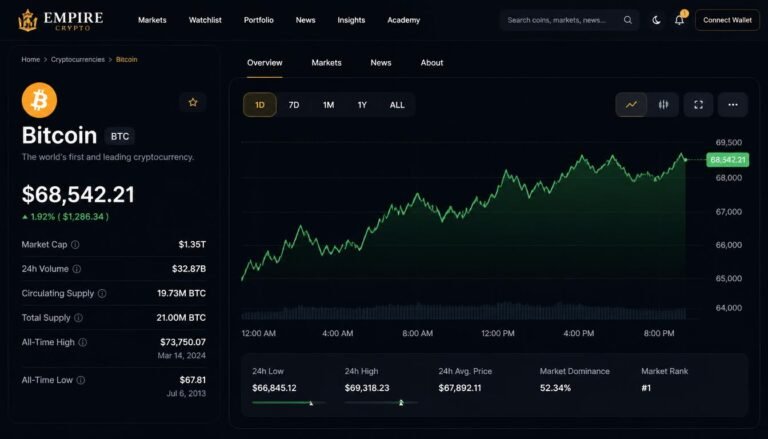
Navigating decentralized finance (DeFi) without reliable information often leads to costly mistakes. At Empire Crypto, we deliver actionable insights, precise market metrics, and expert strategies to help both beginners and intermediate investors achieve sustainable financial growth. DeFi removes traditional banking intermediaries, replacing centralized oversight with automated smart contracts, liquidity pools, and peer-to-peer protocols.

What is Decentralized Finance (DeFi)?
Decentralized Finance, commonly known as DeFi, represents an open alternative to traditional banking. Instead of relying on central authorities like banks, brokerages, or clearinghouses, DeFi applications (dApps) run on permissionless blockchain networks like Ethereum, Solana, Arbitrum, and BNB Chain.
+-----------------------------------------------------------------+
|                    TRADITIONAL FINANCE (CeFi)                  |
|  User ---> Central Bank / Broker ---> Custody & Intermediary   |
+-----------------------------------------------------------------+
                                VS
+-----------------------------------------------------------------+
|                    DECENTRALIZED FINANCE (DeFi)                 |
|  User ---> Smart Contract (Blockchain) ---> Direct Self-Custody|
+-----------------------------------------------------------------+
Key Components of the DeFi Ecosystem
- Smart Contracts: Self-executing digital contracts that execute terms automatically when conditions are met.
- Decentralized Exchanges (DEXs): Platforms enabling peer-to-peer trading directly from your private wallet without deposit intermediaries.
- Liquidity Pools: Smart contract reserves of tokens that facilitate frictionless trading, borrowing, and yield generation.
- Automated Market Makers (AMMs): Algorithmic systems that calculate token prices based on supply and demand ratios rather than order books.
At Empire Crypto, we analyze millions of protocol interactions to deliver accurate cryptocurrency market data, ensuring investors evaluate protocols based on real metrics rather than hype.
Why Crypto Data and Analytics Matter in DeFi Investing
Investing in DeFi without real-time metrics is equivalent to flying blindly in bad weather. Because Web3 markets operate continuously 24/7/365, static price checking is insufficient. Success demands advanced data analytics cryptocurrency tools to evaluate hidden protocol risks.
The Role of High-Quality Crypto Data
Evaluating protocols requires examining core indicators to assess solvency and security:
| Metric | Why It Matters | What to Look For |
| Total Value Locked (TVL) | Measures overall collateral committed to a protocol. | Steady or growing TVL over 90+ days. |
| Volume-to-TVL Ratio | Indicates capital efficiency and usage activity. | High transaction volumes relative to total deposits. |
| Protocol Revenue | Shows real cash flow generated from platform fees. | Consistent revenue distributed to token holders. |
| Token Emission Rate | Tracks inflationary pressure on governance assets. | Sustainable tokenomics without aggressive diluted supply. |
Using best crypto data systems from Empire Crypto helps investors distinguish between protocols growing organically and those reliant on temporary, unsustainable token incentives. Accessing robust crypto data solutions ensures your portfolio decisions rely on verified cryptocurrency data reliability.
About Empire Crypto Data
Empire Crypto is a specialized educational and crypto data company committed to simplifying Web3 investing. Whether you are setting up your first Web3 wallet or constructing sophisticated multi-chain yield strategies, Empire Crypto supplies essential analytical insights.
              +-----------------------------------+
              |        EMPIRE CRYPTO HUB          |
              +-----------------------------------+
                                |
        +-----------------------+-----------------------+
        |                                               |
+---------------+                               +---------------+
|   ON-CHAIN    |                               |   STRATEGIC   |
|   ANALYTICS   |                               |   EDUCATION   |
+---------------+                               +---------------+
        |                                               |
  * TVL Tracking                                  * DeFi Step-by-Step
  * Real Volume Metrics                           * Yield Farming Guides
  * Wallet Activity                               * Risk Management
Core Offerings from Empire Crypto Data:
- Real-Time Data Analysis Cryptocurrency: Continuous monitoring of liquidity shifts, token burns, and contract whale movements.
- Transparent Cryptocurrency Data: Unbiased metrics that filter out wash trading and artificially inflated volumes.
- Educational Blueprints: Actionable guides written specifically for beginner and intermediate investors exploring decentralized markets.
By integrating cryptocurrency data analytics into everyday workflows, Empire Crypto enables users to execute smarter trades while protecting capital from predatory protocols.
Fundamental DeFi Investment Strategies for Beginners
Entering decentralized finance requires a progressive, risk-conscious strategy. Beginners should focus on foundational, low-complexity yield methods before exploring advanced strategies.
       [Beginner Pathway]                       [Intermediate Pathway]

  +--------------------------+              +--------------------------+
  |  1. Liquid Staking       |              |  1. Dual-Asset LP Pools  |
  |     (Base Yield)         |              |     (Concentrated)       |
  +--------------------------+              +--------------------------+
               |                                         |
               v                                         v
  +--------------------------+              +--------------------------+
  |  2. Lending Stablecoins  |              |  2. Cross-Chain Yield    |
  |     (Minimal Volatility) |              |     Arbitrage            |
  +--------------------------+              +--------------------------+
Strategy 1: Staking Native Blockchain Assets
Staking involves locking native tokens (such as ETH, SOL, or AVAX) to help secure Proof-of-Stake (PoS) blockchains. In return, network validators distribute consensus rewards directly to your wallet.
- Risk Level: Low to Moderate
- Average Yield: 3% – 7% APY
- Best Practice: Utilize liquid staking protocols (e.g., Lido, Rocket Pool) to keep your staked assets liquid while earning background rewards.
Strategy 2: Stablecoin Lending
Lending pegged assets (USDC, USDT, PYUSD) on decentralized money markets like Aave or Compound provides steady interest yields without exposing capital to volatile asset fluctuations.
- Risk Level: Low
- Average Yield: 4% – 10% APY
- Best Practice: Check real-time crypto market data on Empire Crypto to identify money markets with high utilization rates and robust insurance funds.
Strategy 3: Single-Sided Asset Vaults
Single-sided vaults aggregate user deposits to execute simple yield generation strategies automatically, removing the risk of impermanent loss experienced in dual-token liquidity pools.
Advanced Yield Strategies for Intermediate Investors
Once comfortable with basic staking and lending, intermediate investors can explore strategies that optimize capital efficiency.
Strategy 1: Concentrated Liquidity Provision
Modern decentralized exchanges (like Uniswap v3/v4) allow liquidity providers to specify custom price ranges for their capital. Narrower ranges capture significantly higher trading fee distributions, but require active monitoring.
Example: Providing ETH/USDC liquidity strictly between $2,800 and $3,500 yields significantly more fees than full-range liquidity, provided the market stays within that targeted corridor.
Strategy 2: Delta-Neutral Yield Farming
Delta-neutral farming aims to harvest yield rewards while completely hedging out underlying asset price risk.
- Spot Long: Buy $1,000 worth of ETH on a spot market and deposit it into a yield farm.
- Perpetual Short: Open a 1x short position for $1,000 worth of ETH on a decentralized perpetual exchange (e.g., dYdX, Hyperliquid).
- Result: Market price movements cancel out, leaving the investor to collect net yield rewards from funding rates and liquidity incentives.
Utilizing trading data analysis cryptocurrency tools from Empire Crypto ensures you maintain optimal hedge ratios and avoid liquidation risks during market swings.
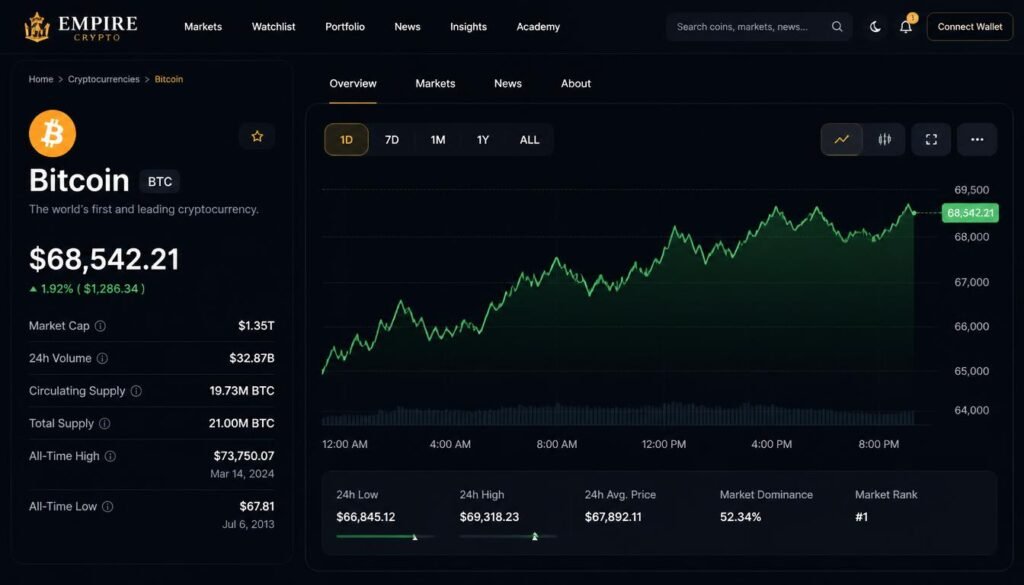
How to Analyze DeFi Protocols Using Cryptocurrency Data
Evaluating a protocol’s health before committing funds is crucial to avoiding smart contract exploits and rug pulls.
+-----------------------------------------------------------------+
|               PROTOCOL AUDIT CHECKLIST (EMPIRE CRYPTO)          |
+-----------------------------------------------------------------+
| Smart Contract Audits (3+ Independent Top-Tier Firms)           |
| Multi-Sig Treasury Controls (No Single-Owner Admin Keys)        |
| Organic TVL Distribution (No Single Whale > 30% Pool Share)     |
| Verified Timelock Implementation (Min 48h Parameter Change)     |
| Active Bug Bounty Program (Immunefi Listed)                     |
+-----------------------------------------------------------------+
1. Smart Contract Security Checks
Always verify whether a protocol’s code has been audited by reputable cybersecurity firms like OpenZeppelin, Trail of Bits, or CertiK. Audits do not completely eliminate risk, but they confirm code adheres to standard security practices.
2. Assessing Liquidity Depth
Evaluating liquidity depth prevents severe slippage when entering or exiting positions. High TVL distributed across thousands of independent wallets indicates a healthy ecosystem, whereas concentrated TVL held by a few wallet addresses poses centralization risks.
3. Reviewing Tokenomics and Inflation
Examine whether reward yields stem from genuine protocol revenue (trading fees, borrowing interest) or token emissions. Token emission-based rewards dilute long-term value unless accompanied by persistent platform usage.
- Real Yield: Generated from actual user fees paid to the protocol.
- Emissions Yield: Derived from minting new tokens, creating inflationary selling pressure.
Empire Crypto tracks these exact metrics so investors can focus on platforms generating genuine, real-yield returns.
Risk Management and Smart Security Frameworks
High returns in DeFi are inextricably linked to real risks. Establishing strong risk management procedures preserves capital during unexpected volatility.
                         [CAPITAL RISK ALLOCATION]

                      +-----------------------------+
                      |   Core Blue-Chip (50%)      |
                      |   ETH, BTC, Staked Assets   |
                      +-----------------------------+
                                     |
                      +-----------------------------+
                      |   Stablecoin Yield (30%)    |
                      |   Aave, Compound, Curve     |
                      +-----------------------------+
                                     |
                      +-----------------------------+
                      |  High-Yield Tactical (20%)  |
                      |  DEX Pools, New Protocols   |
                      +-----------------------------+
Essential DeFi Risk Categories
- Smart Contract Vulnerability: Bugs or logic flaws in protocol code exploited by malicious actors.
- Impermanent Loss: Divergence loss occurring when providing liquidity to volatile asset pairs whose relative prices shift significantly.
- De-pegging Risk: The threat of stablecoins losing their 1:1 parity with underlying fiat currencies.
- Oracle Failure: Manipulation of off-chain price feeds used by lending markets to calculate liquidations.
Operational Security Best Practices
- Hardware Wallet Usage: Never keep primary investment funds in hot browser extensions. Connect cold storage hardware wallets (Ledger, Trezor, Keystone) for transaction signing.
- Revoke Active Approvals: Regularly use token approval managers (e.g., Revoke.cash) to cancel unlimited smart contract permissions granted to dApps.
- Isolate Risk Capital: Use separate, dedicated wallet addresses for interacting with new or unproven yield protocols.
Leveraging crypto data solution toolsets provided by Empire Crypto helps investors track network security events and contract vulnerabilities proactively.
Real-World DeFi Case Studies
To understand how structured analytical strategies perform in live conditions, let’s examine two real-world scenarios.
Case Study A: The Impermanent Loss Trap (Unmanaged Liquidity)
An investor deposited equal values of ETH and a volatile altcoin into a 50/50 liquidity pool yielding 80% APY. Over six months, the altcoin dropped 75% relative to ETH.
- Initial Investment: $5,000 ETH + $5,000 Altcoin ($10,000 Total)
- Yield Earned: $2,200 in reward tokens
- Final Pool Value: $4,100 due to impermanent loss
- Net Result: Loss of $3,700 despite earning high advertised yields.
Lesson: High advertised yields often mask severe underlying impermanent loss. Empire Crypto provides cryptocurrency market data calculators to simulate pool outcomes before committing capital.
Case Study B: Sustainable Real-Yield Accumulation
An investor allocated $10,000 across blue-chip lending markets and stablecoin liquidity pools focused exclusively on platform revenue distribution.
- Allocation: 60% USDC on Aave (6% APY), 40% ETH/USDC concentrated liquidity pool (18% APY)
- Portfolio Rebalancing: Quarterly based on data crypto insights from Empire Crypto
- Net 12-Month Result: Steady 10.8% return ($1,080 profit) with zero capital degradation or impermanent loss impairment.
Frequently Asked Questions (FAQ)
What makes Empire Crypto different from other crypto market data sites?
Empire Crypto combines real-time on-chain metrics, cryptocurrency data reliability validation, and clear educational guides. We focus on removing noise so investors can analyze protocols based on verified, real-world data.
Is DeFi safe for total beginners?
DeFi carries inherent smart contract and market risks. However, beginners can safely enter the ecosystem by starting with hardware wallets, focusing on battle-tested protocols (like Aave or Lido), and avoiding high-leverage positions.
How do I calculate yield returns accurately?
Yields in DeFi are typically expressed as APY (Annual Percentage Yield, accounting for compounding) or APR (Annual Percentage Rate, simple interest). Use cryptocurrency data analytics tools on Empire Crypto to view net-of-fee yield estimates.
What is impermanent loss, and can it be avoided?
Impermanent loss occurs when the relative price of paired assets in a liquidity pool changes compared to when you deposited them. You can avoid impermanent loss entirely by participating in single-sided staking, holding single-asset vaults, or providing liquidity exclusively to pegged stablecoin pools.
How does Empire Crypto verify cryptocurrency data reliability?
Empire Crypto aggregates raw on-chain transactions directly from blockchain nodes, filtering out wash trading volume, fake liquidity metrics, and circular protocol loops to present clear crypto data.
Conclusion: Take Control of Your Financial Future with Empire Crypto
Decentralized finance offers unprecedented financial autonomy, enabling anyone with an internet connection to earn yields, trade assets, and access capital without centralized permission. However, long-term success requires moving past hype and relying on structured analysis, risk controls, and accurate protocol metrics.
By utilizing best crypto data insights, tracking real-time liquidity trends, and following disciplined risk management protocols, you can confidently navigate Web3 ecosystems. Empire Crypto remains dedicated to serving as your trusted guide, offering up-to-date data analytics cryptocurrency tools, step-by-step educational guides, and verified insights.