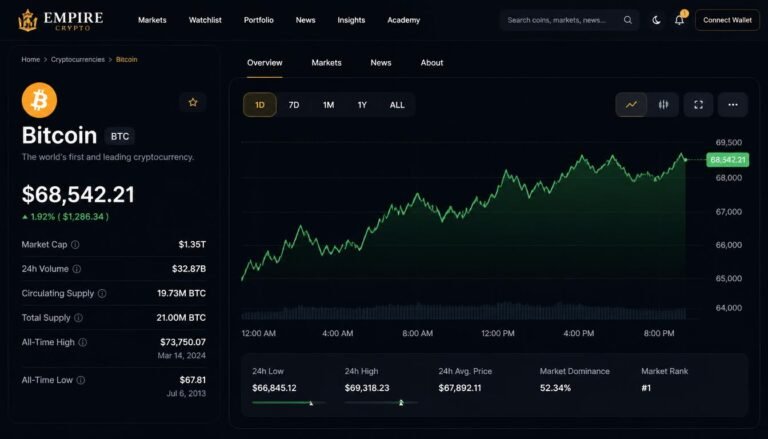
Bitcoin has evolved from an experimental whitepaper into a multi-trillion-dollar global store of value. Today, institutional spot ETFs, nation-state reserves, enterprise corporate treasuries, and Layer-2 payment channels settle billions of dollars in volume daily. To build wealth and preserve capital in this fast-moving environment, relying on accurate cryptocurrency data and actionable analytical tools is essential. At Empire Crypto, we deliver enterprise-grade trading data analysis cryptocurrency platforms, on-chain telemetry, and educational resources designed to keep you ahead of market cycles.

What Is Bitcoin?
At its foundation, Bitcoin is a decentralized, peer-to-peer electronic cash system introduced by the pseudonymous creator Satoshi Nakamoto. Unlike traditional fiat currencies—such as the US Dollar or Euro, which are printed by central banks—Bitcoin operates on an immutable digital ledger known as a blockchain.
┌─────────────────────────────────────────────────────────────┐
│                 CENTRALIZED VS DECENTRALIZED                │
├──────────────────────────────┬──────────────────────────────┤
│      Fiat Banking Engine     │      Bitcoin Peer-to-Peer    │
│  - Central Bank Discretion   │  - Fixed Code Mechanics      │
│  - Inflationary Coin Supply  │  - Hard-Capped 21M Limit     │
│  - Intermediary Settlement   │  - Trustless On-Chain Ledger │
└──────────────────────────────┴──────────────────────────────┘
Three core characteristics define how Bitcoin operates:
- Fixed Monetary Scarcity: Bitcoin has a hardcoded total supply limit of 21 million coins. Over 20 million Bitcoins have already been mined, meaning less than 5% of all BTC remains to be issued over the next century.
- Decentralization: No corporate board, government, or central bank controls the Bitcoin network. Thousands of independent global nodes continuously validate transactions.
- Absolute Transparency: The complete history of every transaction is permanently stored on the public ledger, making auditing simple using specialized data crypto tools.
By leveraging analytical tools from Empire Crypto, investors can monitor active address growth, mining network health, and liquid exchange reserve balances before allocating capital.
2. How the Bitcoin Blockchain Works
To understand Bitcoin, you must understand how a blockchain processes data. A blockchain is an append-only digital ledger made up of sequential, cryptographically linked “blocks” of transaction data.
┌─────────────┐       ┌─────────────┐       ┌─────────────┐
│   Block 1   │  ──►  │   Block 2   │  ──►  │   Block 3   │
│ Hash: 0001a │       │ Hash: 0002b │       │ Hash: 0003c │
│ Prev: 00000 │       │ Prev: 0001a │       │ Prev: 0002b │
└─────────────┘       └─────────────┘       └─────────────┘
1.Transaction Broadcast:Signing & Transmission.
A user initiates a transaction from their wallet. The transfer is cryptographically signed with their private key and broadcasted across the peer-to-peer node network.
2.Mempool Validation:Network Consensus.
Independent network nodes verify that the sender possesses sufficient unspent funds and that the digital signature is authentic.
3.Mining Block Creation:Proof-of-Work.
Specialized ASIC mining hardware competes to solve cryptographic hash puzzles, bundling valid mempool transactions into a new candidate block.
4.Global Sync:Immutable Settlement.
The mined block is permanently attached to the blockchain. The updated ledger synchronizes globally across all nodes, settling the transaction forever.
3. Bitcoin Supply Math: Halvings, Scarcity, and Lost Coins
Understanding Bitcoin’s price trajectory requires grasping its programmatic issuance mechanics. New Bitcoins enter circulation strictly through block rewards paid to miners.
The Halving Engine
Every 210,000 blocks (roughly every four years), the issuance rate of new BTC drops by 50%.
| Halving Event | Approximate Year | Block Reward | Daily BTC Issuance |
| Genesis Block | 2009 | 50.0 BTC | ~7,200 BTC |
| 1st Halving | 2012 | 25.0 BTC | ~3,600 BTC |
| 2nd Halving | 2016 | 12.5 BTC | ~1,800 BTC |
| 3rd Halving | 2020 | 6.25 BTC | ~900 BTC |
| 4th Halving | 2024 | 3.125 BTC | ~450 BTC |
| 5th Halving (Upcoming) | April 2028 | 1.5625 BTC | ~225 BTC |
The True Circulating Supply
While the protocol caps total supply at 21 million BTC, on-chain crypto market data confirms that an estimated 2.3 to 3.7 million coins are permanently lost due to abandoned wallets, lost hardware drives, or early unbacked keys. This makes Bitcoin effectively deflationary over long time horizons.
                            ┌────────────────────────┐
                            │ BITCOIN SUPPLY DYNAMICS│
                            └───────────┬────────────┘
                                        │
        ┌───────────────────┬───────────┴───────────┬───────────────────┐
        ▼                   ▼                       ▼                   ▼
  ┌───────────┐       ┌───────────┐           ┌───────────┐       ┌───────────┐
  │ 21M Cap   │       │ >20M Mined│           │ ~3M Lost  │       │ Real Liquid│
  │ Hardcode  │       │ Issued    │           │ Inaccessible│     │ Supply    │
  └───────────┘       └───────────┘           └───────────┘       └───────────┘
Using real-time telemetry from Empire Crypto, traders track these illiquid supply movements, whale wallet accumulation trends, and exchange reserves to gauge market sentiment.
4. Setting Up Your Wallet and Securing Private Keys
In cryptocurrency, self-custody gives you complete financial sovereignty. If you control your private keys, no third party can freeze your assets. Follow this step-by-step setup procedure:
- Step 1: Distinguish Between Public and Private KeysYour Public Address (starting with
1...,3..., orbc1...) acts like a bank IBAN—you can share it safely to receive funds. Your Private Key (and its human-readable 12- or 24-word Secret Recovery Phrase) is your master signature. Whoever holds this phrase owns the assets. - Step 2: Choose Hardware Cold StorageStore long-term reserves in offline Hardware Wallets (e.g., Ledger, Trezor, Coldcard). Use software hot wallets on phones or browsers strictly for small daily transactions.
- Step 3: Backup Physical CredentialsWrite down your recovery phrase on paper or stamp it onto stainless steel plates. Never store private keys in cloud storage, text notes, email drafts, or digital photos.
- Step 4: Connect with Empire Crypto Tracking SystemsLink your public wallet address to Empire Crypto tracking engines to review portfolio growth, historical acquisition costs, and wallet risk scores without exposing private keys.
5. Essential On-Chain Metrics Every Investor Must Master
Evaluating digital assets accurately requires looking beyond superficial price action. On-chain analytics reveal the underlying network usage and liquidity shifts driving long-term value.
Key On-Chain Metrics
- Network Hashrate: Measures the total computing power dedicated to securing the network. A rising hashrate indicates high network security and miner confidence.
- MVRV Z-Score: A metric that compares Bitcoin’s market capitalization against its realized capitalization (the value based on when each coin last moved on-chain). It helps identify macro market cycle tops and generational buying bottoms.
- Stock-to-Flow (S2F) Ratio: Evaluates supply scarcity by dividing existing circulating coins by annual newly mined production.
┌─────────────────────────────────────────────────────────────┐
│                 EMPIRE ON-CHAIN TELEMETRY                   │
├──────────────────────────────┬──────────────────────────────┤
│     Network Security Depth   │    Macro Valuation Metrics   │
│  - Total Network Hashrate    │  - Realized Price / Basis    │
│  - Mining Difficulty Bounds  │  - MVRV Z-Score Bands        │
│  - Hashprice Profitability   │  - Exchange Outflow Velocity │
└──────────────────────────────┴──────────────────────────────┘
Relying on a professional crypto data company like Empire Crypto provides access to verified datasets, helping you filter out noise and identify true value.
6. Advanced Market Strategies: Mining Dynamics and Dollar-Cost Averaging
Once you master wallet basics, applying structured accumulation and risk management strategies helps preserve capital through volatile market phases.
Dollar-Cost Averaging (DCA)
Dollar-cost averaging involves buying a fixed fiat amount of Bitcoin on scheduled intervals (e.g., weekly or monthly) regardless of price fluctuations. DCA neutralizes emotional timing stress and lowers average purchase costs over extended cycles.
Understanding Mining Hashprice and Energy Economics
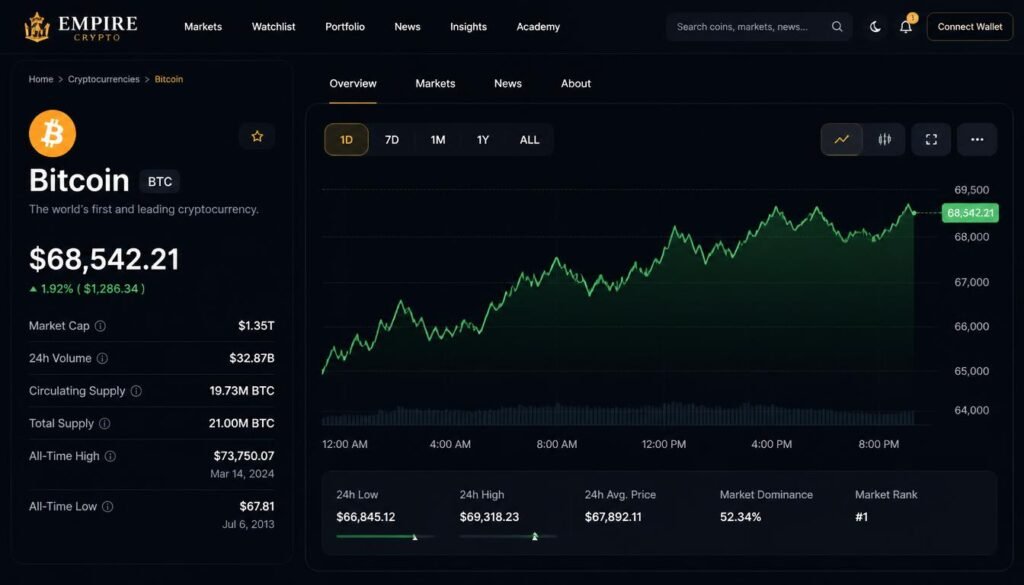
For advanced participants, tracking miner economics provides structural market insights. Hashprice measures the daily revenue miners earn per unit of computing power.
When hashprice drops below production costs, inefficient miners capitulate, often signaling macro price floors. Empire Crypto provides specialized crypto data solution toolkits that aggregate miner hashprice, energy efficiency models (J/TH), and hardware difficulty adjustments.
Real-World Example: During severe winter grid shutdowns or market pullbacks, miner hashpower temporarily drops. Traders using Empire Crypto metrics monitor these difficulty retargets to spot potential trend reversals before broader market recovery.
7. Common Mistakes Beginners Must Avoid
- Leaving Core Reserves on Centralized Exchanges: Exchanges carry counterparty, solvency, and regulatory risks. Move long-term holdings to self-custody wallets.
- Using High Margin Leverage: Excessive leverage leads to sudden liquidations during normal volatility spikes.
- Falling for Phishing Scams: Hardware wallet manufacturers, support teams, or exchanges will never ask for your 12-word recovery phrase.
- Ignoring Tax Recordkeeping: Keep complete records of every transaction to streamline annual tax reporting and ensure compliance.
8. About Empire Crypto Data Solutions
At Empire Crypto, our mission is to empower individual and institutional investors with clean, actionable crypto market data. Succeeding in Web3 requires verified facts rather than social media speculation; Empire Crypto transforms raw blockchain logs into clear, actionable dashboards.
┌─────────────────────────────────────────────────────────────┐
│                 EMPIRE CRYPTO DATA SUITE                    │
├─────────────────────────────────────────────────────────────┤
│  ✓ Institutional-Grade Order Book & Liquidity Analytics     │
│  ✓ On-Chain Whale & Reserve Wallet Movement Tracking        │
│  ✓ Multi-Chain Hashrate & Mining Profitability Metrics      │
│  ✓ Customizable Risk Monitoring & Automated Market Alerts   │
└─────────────────────────────────────────────────────────────┘
By delivering specialized data analytics cryptocurrency infrastructure, Empire Crypto provides scalable crypto data solutions backed by complete cryptocurrency data reliability. Partnering with Empire Crypto allows you to track market liquidity, analyze institutional activity, and manage risk with total clarity.
9. Frequently Asked Questions (FAQ)
Is Bitcoin safe for complete beginners?
Yes, provided you prioritize self-custody security, store seed phrases offline, and base investment decisions on reliable market metrics rather than social media hype.
How does Empire Crypto enhance my Bitcoin research?
Empire Crypto supplies advanced cryptocurrency data analytics, real-time portfolio tracking dashboards, and simple educational guides so you can make informed, data-backed decisions.
What happens when all 21 million Bitcoins are mined?
Once the final Bitcoin is issued around the year 2140, miners will no longer receive new block rewards. Instead, they will be incentivized entirely by transaction fees paid by network users.
How can I verify cryptocurrency data reliability?
Empire Crypto aggregates raw data directly from validated blockchain nodes and global exchange order books, processing it through multi-layered verification engines to ensure total accuracy.
Master Bitcoin with Empire Crypto
Bitcoin offers generational financial opportunities, but capturing long-term value requires discipline, verified information, and effective risk controls.
By pairing foundational blockchain knowledge with real-time cryptocurrency market data from Empire Crypto, you build a resilient, informed investment strategy built for sustainable success.
Take charge of your financial future today. Explore the analytical tools, tracking dashboards, and educational guides at Empire Crypto to master the digital asset space!