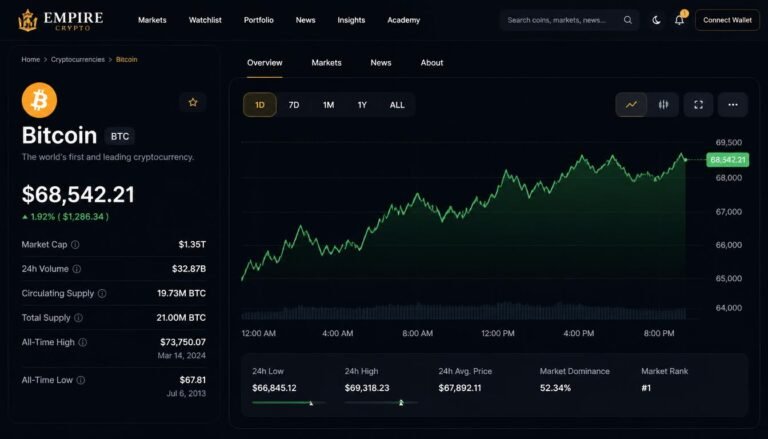
The decentralized technology ecosystem has matured into a production-grade infrastructure layer for global finance, computing, and digital identity. Because public blockchains operate as transparent, peer-to-peer state machines, they record every token migration, execution cost, and smart contract state change live onto immutable public ledgers. For students, technical analysts, and software engineers, this open-data paradigm means you no longer have to rely on central gatekeepers to analyze economic networks.
However, translating millions of raw, hex-encoded transaction strings into actionable intelligence presents a steep learning curve. The key to mastering this space without confusion is balancing structural cryptography theory with hands-on, data-driven toolsets. This guide profiles the premier online educational tools, interactive platforms, and data stacks designed to take you from a Crypto Data Online beginner to a confident on-chain data professional.

1. The Core Architecture: Understanding Ledger Data
Before deploying advanced data tools, a blockchain analyst must understand the different data environments generated by distributed software systems. Blockchain data is structurally divided into two primary tracks:
                      ┌───────────────────────────────────┐
                      │    BLOCKCHAIN DATA ENVIRONMENTS   │
                      └─────────────────┬─────────────────┘
                                        │
            ┌───────────────────────────┴───────────────────────────┐
            ▼                                                       ▼
 ┌─────────────────────────────────────┐                 ┌─────────────────────────────────────┐
 │         ON-CHAIN DATA LAYER         │                 │        OFF-CHAIN DATA LAYER         │
 ├─────────────────────────────────────┤                 ├─────────────────────────────────────┤
 │ • Block headers & consensus proofs  │                 │ • Centralized order books (CEX)     │
 │ • Smart contract event logs         │                 │ • Derivative funding rates          │
 │ • Gas consumption & transaction fees│                 │ • Social media sentiment streams    │
 └─────────────────────────────────────┘                 └─────────────────────────────────────┘
The On-Chain Layer (The Immutable Record)
On-chain data represents any information written natively into a block that has achieved network consensus. This layer contains the indisputable structural truth of the network: wallet balances, smart contract execution steps, and chronological timestamps. It is entirely permanent, audit-ready, and public.
The Off-Chain Layer (The Discovery Context)
Off-chain data consists of metrics generated outside the distributed network state machine. This encompasses centralized exchange (CEX) spot order books, macro search query trends, and token derivatives data. While off-chain metrics reflect real-time market discovery and human sentiment, they must be validated against actual on-chain usage to confirm their long-term Crypto Data Online.
2. Standout Crypto Data Platforms for Hands-On Learning
Educational materials are only as good as the tools you use to apply them. The following data suites offer robust free tiers and specialized visual sandboxes designed to bridge the gap between abstract theory and real-world numbers:
A. DeFiLlama: Protocol Fundamentals and Crypto Data Online Health
For analyzing the economic viability of decentralized applications ($dApps$), DeFiLlama is the ultimate baseline open-source tool.
- What it teaches: Students learn to track Total Value Locked (TVL)—the net dollar value of assets locked inside a protocol’s smart contracts as collateral.
- Core Utility: Beyond basic TVL, the platform isolates actual fee generation, protocol revenues, and active user growth metrics, teaching users to evaluate Web3 networks like traditional cash-flow businesses.
B. Dune Analytics: Relational SQL Database Education
If you want to transition from viewing simple charts to executing custom data queries, Dune Analytics is an invaluable open-source resource.
- What it teaches: Dune aggregates raw, unorganized blockchain logs into accessible relational databases.
- Core Utility: The platform allows students to write standard SQL (Structured Query Language) scripts directly inside a browser terminal to filter, parse, and visualize transaction records. Users can fork existing community dashboards, deconstruct the underlying code, and build customized data visualizers.
C. Glassnode & CryptoQuant: Macro Crypto Data Online Metrologies
For studying the economic cycles of primary Layer-1 networks like Bitcoin and Ethereum, Glassnode and CryptoQuant serve as the industry standards.
- What it teaches: These platforms focus on systemic network health, validator behaviors, and investor holding periods (such as HODL waves or Spent Output Profit Ratio modeling).
- Core Utility: They demonstrate how block parameters (like mining hash rates or validator Crypto Data Online events) connect directly to macroeconomic liquidity shifts.
3. Trusted Digital Academies and Web3 Bootcamps
To turn these data platforms into professional-grade Crypto Data Online, pair them with structured educational ecosystems that emphasize hands-on coding and data auditing:
| Academy Provider | Primary Learning Track | Core Practical Skills | Enrollment Cost |
| Cyfrin Updraft | Smart Contract Development & Security Auditing | Coding Solidity, writing unit tests, and detecting critical codebase security flaws. | 100% Free |
| Alchemy University | Web3 Engineering Infrastructure | JavaScript-to-blockchain interactions, configuring RPC nodes, and managing Account Abstraction. | 100% Free |
| CryptoZombies | Gamified Smart Crypto Data Online Basics | Writing Solidity code logic through interactive, puzzle-based game design. | 100% Free |
Interactive Tool Spotlight: Cyfrin Updraft & CodeHawks
Cyfrin Updraft stands out by providing a thorough, end-to-end curriculum spanning over 50 hours of professional technical instruction. Rather than relying on passive video lectures, students write real smart contracts locally, run advanced debugging suites, and transition directly into Crypto Data Online —a competitive public smart contract auditing arena. Here, users can apply their skills to live codebases, hunt for logic flaws, and gain practical experience that aligns perfectly with full-time security engineering roles.

4. Fundamental Cryptographic Calculations and Logic Models
To accurately parse the information displayed on crypto data sites, you must master the fundamental mathematical formulas that dictate protocol health.
The Network Adoption Equation (Crypto Data Online Law)
The organic utility of a public blockchain network scales exponentially alongside its user footprint. Metcalfe’s Law asserts that the systemic financial value ($V$) of a network is directly proportional to the square of its daily active unique users ($N$):
$$V \propto N^2$$
When utilizing analytics tools like Coin Metrics or Glassnode, a sharp divergence where token prices spike while daily active address vectors remain flat indicates that a trend is driven by short-term speculation rather than actual network adoption.
Real Protocol Profit Margin Adjustments
Many decentralized platforms mask low user demand by inflating their trading volume through subsidized token distributions. To identify a dApp’s true financial viability, apply this cash-flow calculation:
$$\text{Net Protocol Revenue} = \text{Total Transaction Fees Collected} – \text{Supply-Side Token Emissions}$$
If an automated lending app collects $\$5,000,000$ in user fees but emits $\$8,000,000$ worth of highly inflationary governance tokens to bribe liquidity providers to use the platform, its net operational margin remains structurally negative.
5. A Project-Driven 90-Day Technical Mastery Roadmap
The most efficient path to technical blockchain data literacy is built on structured, project-driven milestones. This 90-day timeline is designed to systematically build your data extraction and analysis skills:
1.Phase 1 (Days 1 – 30): Micro-Ledger Fluency:Focus: Block Explorers & Raw Forensics.
Open a mainnet block explorer like Etherscan or Solscan. Isolate 20 different transaction hashes ($TxIDs$). Manually trace the exact execution paths: find the originating wallet, decode the inputs passed to the contract bytecode, calculate the precise gas units consumed, and verify how the balances updated across the participating public addresses.
2.Phase 2 (Days 31 – 60): Macro Financial Modeling:Focus: Aggregators & Valuation Frameworks.
Utilize DeFiLlama and Token Terminal. Pick three competing Layer-2 scaling rollups. Build an offline spreadsheet mapping out their 30-day rolling transactional velocities, median gas fees, stablecoin migration paths, and capital efficiency ratios ($TVL$ divided by daily volume). Identify mathematically which chain offers the best throughput efficiency.
3.Phase 3 (Days 61 – 90): Relational Database Engineering:Focus: SQL Queries & Custom Dashboards.
Log into a developer sandbox console on Dune Analytics or Flipside Crypto. Study the platform’s schema documentation to understand how raw logs are organized into tables. Write a custom SQL script that tracks large fund flows (e.g., wallet transfers exceeding $\$500,000$) for a specific token contract and generate a clean, public chart displaying your findings.
6. The Evolution of Modern Analytical Learning Toolchains
As blockchain networks scale, the tools used to study them are becoming more interactive and intuitive:
- AI-Powered Code Copilots: Modern environments like Flipside Crypto integrate specialized AI developer agents directly into their interfaces. If a student writes an imperfect SQL query or runs into a syntax error, the embedded AI automatically reviews the database schema, corrects the code, and explains the optimization step-by-step.
- Holder Cluster Visualization (Bubblemaps): Advanced visual security tools like Bubblemaps turn complex wallet transaction histories into clear, color-coded bubble charts. This allows users to instantly spot hidden wallet clusters, identify insider token control, and audit the true decentralization of a token launch without reading through thousands of rows of spreadsheets.
The Analyst’s Mandate: The core guiding principle of decentralized technology is “Don’t trust, verify.” By moving past high-level market commentary and mastering raw data tools, you build highly sought-after, employable skills. Armed with these on-chain analytics platforms, you gain the clarity needed to navigate the future of global digital infrastructure with Crypto Data Online.