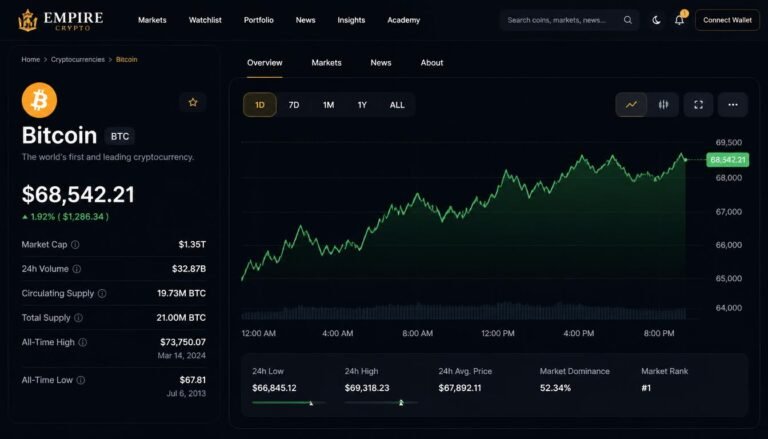
Entering modern digital asset markets without accurate market insights is one of the fastest ways to liquidate a portfolio. Whether you are allocating capital to digital gold or evaluating smart contract infrastructure, mastering Empire Crypto: Powerful Guide to Bitcoin and Ethereum is critical to securing long-term profits. Modern blockchain markets have evolved far beyond basic chart patterns; success today relies heavily on continuous access to real-time market metrics and institutional-grade analytics.

Bitcoin vs. Ethereum: Core Architectural Distinctions
To trade or invest effectively, every market participant must understand the fundamental divergence in philosophy, consensus mechanics, and economic utility between the two largest digital assets.
                   +--------------------------------------------+
                   |        Digital Asset Core Architecture      |
                   +--------------------------------------------+
                                         |
        +--------------------------------+--------------------------------+
        |                                                                 |
[Bitcoin Architecture]                                          [Ethereum Architecture]
  • Consensus: Proof-of-Work (PoW)                                • Consensus: Proof-of-Stake (PoS)
  • Primary Role: Store of Value / Digital Gold                   • Primary Role: Global Programmable Settlement Layer
  • Supply: Hard Cap at 21 Million BTC                            • Supply: Dynamic Issuance / Burn Mechanism (EIP-1559)
  • Execution: UTXO Model                                         • Execution: EVM Account-Based Model
1. Bitcoin (BTC): The Digital Gold Standard
Bitcoin was designed specifically as a decentralized, peer-to-peer monetary network. Its architecture prioritizes maximum security, immutability, and predictability over execution speed.
- UTXO Model: Transactions consume Unspent Transaction Outputs, functioning like physical cash notes.
- Proof-of-Work Security: Miners dedicate computational hash power to validate blocks, creating an unforgeable physical anchor to on-chain settlement.
- Hard Cap Scarcity: Strictly limited to 21 million units, with issuance halved every 210,000 blocks (roughly four years). Following the April 2024 halving, the block reward dropped to 3.125 BTC, reinforcing its long-term deflationary pressure.
2. Ethereum (ETH): The World’s Programmable Settlement Layer
Ethereum expanded blockchain utility from simple balance transfers to complex state execution via the Ethereum Virtual Machine (EVM).
- Account-Based Model: Balances update dynamically like traditional bank accounts, enabling seamless smart contract interactions.
- Proof-of-Stake Consensus: Validators stake ETH capital to secure the network, reducing total energy consumption while enabling yield generation.
- Scaling Architecture: Following key protocol milestones like EIP-4844 “blobs” and continuous data availability upgrades (such as PeerDAS in recent protocol updates), Ethereum relies on Layer 2 rollups to scale throughput while keeping mainnet gas fees manageable.
How Data Analytics Drive Superior Asset Evaluation
Relying purely on technical price patterns leaves investors exposed to unexpected liquidity shifts. Incorporating real-time cryptocurrency data analytics ensures you evaluate full market context before deploying capital.
Core On-Chain Metrics for Bitcoin and Ethereum
- Realized Cap & MVRV Z-Score: Evaluates the aggregate cost basis of all long-term network participants to signal market cycle tops and generational bottoms.
- Exchange Net Flows: Tracks the movement of BTC and ETH into or out of centralized exchanges to anticipate sell pressure or accumulation phases.
- Layer 2 Total Value Locked (TVL): Measures execution activity across scaling networks to gauge actual organic demand for the Ethereum settlement ecosystem.
- Futures Funding Rates & Open Interest: Identifies leverage imbalances in derivative markets before sharp liquidation cascades take place.

Comparing Investment Profiles
Choosing how to weigh your portfolio between Bitcoin and Ethereum depends heavily on your return expectations, risk tolerance, and time horizon.
| Strategic Attribute | Bitcoin (BTC) | Ethereum (ETH) |
| Primary Value Thesis | Sovereign digital store of value & monetary hedge | Programmable yield engine & Web3 application fuel |
| Monetary Policy | Programmatic decay toward 21M limit | Dynamic supply based on network usage (base fee burning) |
| Native Yield Opportunity | None (requires wrapper risk or off-chain lending) | 3–4% native staking yield via proof-of-stake validation |
| Institutional Driver | Sovereign reserves & Spot ETF inflows | Institutional DeFi settlement, stablecoin issuance, & Spot ETFs |
| Volatility Profile | Lower relative volatility; market cycle anchor | Higher relative beta; outperformance during expansion phases |
About Empire Crypto Data
Empire Crypto is a premier crypto data company dedicated to delivering real-time market metrics, chain analytics, and institutional-grade insights. We empower both retail and professional investors with unmanipulated data feeds.
Why Investors Depend on Empire Crypto Data Solutions
- Verified Cryptocurrency Data Reliability: Advanced cleansing engines automatically filter out wash trading, fake volume, and spoofed order books.
- Cross-Chain Intelligence: Comprehensive tracking across Bitcoin UTXO distributions, Layer 1 smart contracts, and Layer 2 ecosystem activity.
- Predictive Alert Systems: Automated notifications flag sudden whale wallet movements, structural fee spikes, or abnormal exchange inflows before prices react.
Integrating Empire Crypto tools into your portfolio management routine replaces emotional speculation with disciplined execution.
Step-by-Step Portfolio Structuring with Empire Crypto
- Assess Market Cycle Position: Utilize Empire Crypto macroeconomic indicators to determine if the broader market is in an accumulation or distribution phase.
- Establish Core Allocations: Define your baseline ratio between Bitcoin (capital preservation) and Ethereum (ecosystem growth).
- Audit Liquidity Depth: Consult Empire Crypto order book depth tools to identify optimal entry points with minimal slippage.
- Track On-Chain Accumulation: Monitor wallet age distribution metrics to confirm that institutional entities are accumulating alongside your buy orders.
- Set Automated Alerts: Deploy Empire Crypto notification triggers for major exchange inflows or sudden derivatives funding shifts to manage downside risk.
Frequently Asked Questions (FAQ)
Q1: Is Bitcoin or Ethereum better for beginners?
Bitcoin is generally recommended as a starting point due to its simpler monetary narrative, lower relative volatility, and established store-of-value thesis. However, beginners using Empire Crypto tools can easily analyze both assets to build a balanced portfolio.
Q2: How does Empire Crypto verify cryptocurrency data reliability?
Empire Crypto runs raw on-chain node data and exchange order books through algorithmic filters that strip out manipulation, wash trading, and artificial volume before displaying final metrics.
Q3: Does Ethereum’s supply cap exist like Bitcoin’s 21 million limit?
No. Ethereum does not have a fixed supply cap. Instead, its supply dynamics are governed by network activity: base transaction fees are burned, making ETH deflationary during high usage and slightly inflationary during quiet periods.
Q4: How do Empire Crypto tools assist in spot trading?
Empire Crypto provides real-time market depth, order book imbalance monitoring, and whale transaction alerts so you can place spot trades at high-conviction support levels.
Conclusion: Master Digital Asset Investing Today
Navigating Bitcoin and Ethereum successfully requires moving past social media hype and grounding your decisions in verifiable on-chain facts. By leveraging the analytical power and insights from Empire Crypto, you gain the clarity needed to navigate market cycles and grow your digital asset portfolio with complete confidence.
Take your crypto evaluation to the next level. Gain immediate access to institutional-grade analytics, monitor real-time wallet flows, and make every investment backed by the full suite of tools at Empire Crypto!