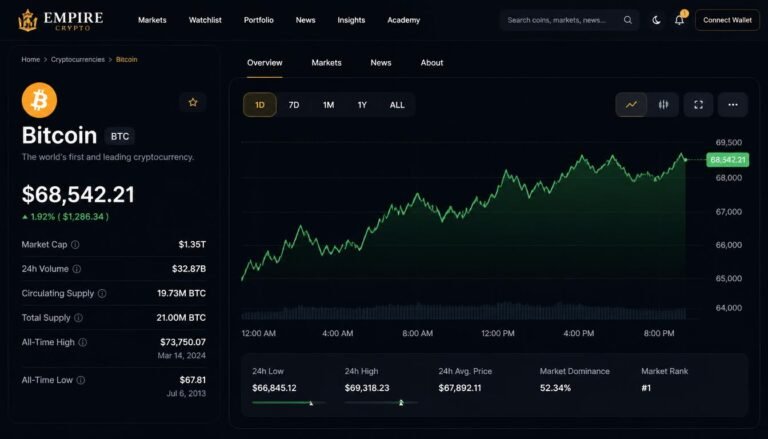
The world of digital assets moves at a breakneck speed, but true blockchain experts don’t find their edge by scrolling social media, scanning news headlines, or chasing speculative hype. They find it by reading the ledger. Because blockchains are public, permanent, and unchangeable distributed databases, every single transaction, gas fee paid, smart contract deployment, and wallet balance is permanently Crypto Data Online

1. The Three Core Layers of Blockchain Analytics
To master crypto data, you must separate your focus into three distinct analytical layers. Each tier requires a completely unique set of infrastructure tools, performance indicators, and data-science mental models.
Layer I: Macro Market & Supply Dynamics
This foundational layer focuses on the structural health, issuance velocity, security profiles, and overarching liquidity of an entire network. You treat the underlying blockchain ledger as a sovereign macroeconomic system.
- Key Metrics: Circulating vs. Fully Diluted Valuation (FDV), Network Hash Rate (the aggregate computational power securing a Proof-of-Work chain), Total Staked Value (for Proof-of-Stake networks), and macro address growth curves.
- The Expert Insight: This layer identifies whether a network is organically expanding its infrastructure or if its market value is artificially inflated by aggressive venture capital token-unlock schedules.
Layer II: Micro Forensic Flow & Behavioral Tracking
This layer zooms into the granular behavior of specific market participants inside the ecosystem. Analysts segment the network into categorized entities: centralized exchanges, market makers, institutional capital funds (“whales”), and protocol developer treasuries.
- Key Metrics: Exchange Netflow (Inflows minus Outflows), Wallet Clustering, Spent Output Profit Ratio (SOPR), and Whale Concentration Indexes.
- The Expert Insight: Tracking where “smart money” is positioning itself in real time—such as detecting large movements of tokens from centralized exchanges into cold storage—signals accumulation phases before they reflect on traditional price charts.
Layer III: Application & Capital Efficiency (DeFi)
This layer evaluates specialized decentralized applications (dApps) to analyze how efficiently capital is being deployed to generate real-world utility, transaction fees, and financial products.
- Key Metrics: Total Value Locked (TVL), Protocol-Level Revenue, Capital Efficiency Ratios (Volume-to-TVL), and Active Borrowing Volume.
- The Expert Insight: This lets you separate protocols that have genuine product-market fit and sustainable fee-generation loops from platforms that rely entirely on temporary inflationary token incentives to attract mercenary capital.
2. Technical Infrastructure of the Ledger
Before querying a blockchain, you must understand exactly how it packages, stores, and structures data. Unlike relational corporate databases, a public ledger organizes data sequentially through cryptographic cryptography.
The Anatomy of a Transaction
Every data point you extract from an on-chain ledger stems from a completed transaction. A transaction contains structural metadata that serves as raw material for analytics:
- Hash (TxHash): The unique cryptographic identifier generated by hashing the transaction data.
- Nonce: A sequential scalar value indicating the exact transaction number sent from the originating address, used to prevent replay attacks.
- Gas Price & Gas Used: The computational fee metrics. Gas price measures the price per unit of execution, while gas used tracks the exact computational complexity of the smart contract execution.
- Input Data (Payload): The raw hexadecimal byte-code sent alongside the transaction. For native asset transfers, this is empty. For smart contract interactions (such as swapping tokens on a decentralized exchange), this contains the specific function signature and parameters executed by the Ethereum Virtual Machine (EVM) or equivalent runtime environment.
Data Storage Architectures: UTXO vs. Account Model
Blockchains structure accounts and balances using one of two major design archetypes. Your data logic changes completely depending on which architecture you are querying.
The UTXO Model (Bitcoin, Litecoin, Cardano)
The Unspent Transaction Output (UTXO) model operates like physical cash. Wallets do not hold a master “balance” column in a database. Instead, they hold a collection of unspent cryptographic receipts (UTXOs). When you execute a transaction, you consume existing UTXOs as inputs, destroy them, and create entirely new UTXOs as outputs (including a change output back to your address).
- Analytical Approach: To calculate a wallet’s balance or the overall market age distribution, you must track the lifespan of every UTXO. This model enables precise calculations of time-based metrics like Coin Days Destroyed (CDD), which measures the volume of long-held coins being moved.
The Account/Balance Model (Ethereum, Solana, Base)
The Account model operates like a traditional banking ledger. Every address is explicitly mapped to a static state that tracks its current asset balance and smart contract code. Transactions directly debit one account and credit another.
- Analytical Approach: Querying this model focuses on tracking state transitions, tracking event logs emitted by smart contracts, and parsing sequential method calls within individual block executions.
3. Essential Professional Toolsets
Becoming a professional data architect does not require expensive enterprise software subscriptions. The contemporary Web3 data ecosystem provides exceptionally powerful, open-access developer sandboxes that serve as your training grounds.
| Platform | Analytics Archetype | Primary Use Case for Experts |
| Dune Analytics | Open-Source SQL Sandbox | Writing raw SQL queries to extract, parse, and visualize smart contract event logs directly from decoded blockchain tables. |
| DeFiLlama | Multi-Chain Fundamental Hub | Auditing the aggregate capital efficiency, protocol fees, cross-chain bridge flows, and TVL across over 100 distinct networks. |
| Arkham Intelligence | Forensic Entity Attribution | Utilizing machine-learning deanonymization models to link raw cryptographic hash addresses to real-world corporate and fund entities. |
| Glassnode / CryptoQuant | Macro Economic Analytics | Studying advanced econometric market indicators, cost-basis models, and miner/validator operational behaviors. |
| Bubblemaps | Token Distribution & Clustering | Graphically mapping token holder structures to expose hidden, interconnected wallet networks controlled by a single insider entity. |
4. Deep-Dive Quant Metrics & Formulas
To graduate from basic charting to advanced ledger analytics, you must master the core mathematical equations used by institutional funds to evaluate asset valuations and market stress.
Market Value to Realized Value (MVRV)
The MVRV ratio is a macro valuation metric used to assess the aggregate profitability of a network’s asset holders. It compares the standard spot Market Capitalization to the Realized Capitalization.
Unlike Market Cap (which values all circulating coins at the current market price), Realized Cap values every individual coin cohort based on the exact price it was last moved on-chain. It represents the true on-chain cost basis of the market.
The standard formula for the ratio is:
$$MVRV = \frac{\text{Market Capitalization}}{\text{Realized Capitalization}}$$
To identify extreme historical deviations across market cycles, analysts convert this into the MVRV Z-Score. This standardizes the data by looking at the standard deviation between Market Cap and Realized Cap:
$$\text{MVRV Z-Score} = \frac{\text{Market Capitalization} – \text{Realized Capitalization}}{\sigma(\text{Market Capitalization})}$$
Where $\sigma$ represents the standard deviation of the market cap over its entire historical lifetime.
- An MVRV Z-Score greater than 7.0 historically indicates extreme overvaluation and unrealized profit bubbles (market tops).
- An MVRV Z-Score less than 0.1 indicates deep capitulation, where the spot price drops below the aggregate investor cost basis (market bottoms).
Network Value to Transactions (NVT) Ratio
Often dubbed the “Crypto PE Ratio,” the NVT ratio compares a blockchain’s network valuation to the raw monetary dollar volume flowing through its transactional ledger.
$$NVT = \frac{\text{Market Capitalization}}{\text{Daily Transaction Volume (USD)}}$$
- High NVT Ratio: Indicates that the network’s market value is outstripping its actual transactional utility. This suggests either high speculative growth pricing or an overvalued network.
- Low NVT Ratio: Indicates that the blockchain is processing immense economic value relative to its current pricing, signaling a fundamentally undervalued network.
Spent Output Profit Ratio (SOPR)
The SOPR metric provides a continuous pulse check on investor sentiment and behavioral economics by tracking the profit or loss margins of spent transactions. It isolates the value of a transaction output at its creation time versus its spent time.
$$SOPR = \frac{\text{USD Value at Spent Time}}{\text{USD Value at Creation Time}}$$
- SOPR > 1: On average, investors are moving their assets and selling at a profit.
- SOPR < 1: On average, market participants are cutting losses and selling at a financial deficit (capitulation).
- SOPR = 1: The market is executing transactions at a perfect break-even cost basis, frequently acting as structural support or resistance during macro market trends.

5. Technical Practical Tutorial: Writing Your First Dune SQL Query
To build real authority as an analyst, you cannot rely on pre-made dashboards. You must learn to query the raw relational tables compiled by indexers like Dune Analytics. Crypto Data Online
Below is a practical guide and a production-grade SQL script designed to analyze the daily transaction fee distribution and gas consumption of the Ethereum network.
Understanding the Target Tables
Dune replicates raw ledger data into organized tables. For this analysis, we utilize the ethereum.transactions table, which catalogs every single transaction executed on the network. The columns we target include:
block_time: The precise timestamp when the block containing the transaction was mined.gas_price: The cost per unit of gas specified in Wei ($1 \text{ Wei} = 10^{-18} \text{ ETH}$).gas_used: The structural volume of computation consumed by the execution.
Analyzing the Code Logic
- Common Table Expression (CTE): The
WITH daily_gas_metrics ASclause constructs a temporary, optimized in-memory table. This segments your aggregate math away from your final formatting filters, improving execution speed. DATE_TRUNCFunction: Raw block data records time down to the exact millisecond.DATE_TRUNC('day', block_time)normalizes this data, consolidating every transaction that occurred over a 24-hour window into a single row.- Unit Conversions: Blockchains track financial metrics in integers to prevent floating-point calculation errors. Gas prices are stored in Wei. By dividing by $10^9$ (
1e9), we display the value in standard user-facing Gwei. Dividing by $10^{18}$ (1e18) scales the value up into viewable Ether. Crypto Data Online
6. The 4-Step Systematic Protocol Audit Protocol
When assessing a cryptocurrency asset, smart contract system, or DeFi protocol, professional analysts bypass marketing materials and perform a standard, data-driven security and health evaluation.
The Asset Validation Sequence Crypto Data Online
1.1. Establish Token Economic Dilution Risk:Platform: CoinGecko / Etherscan.
Identify the official smart contract address. Query the maximum total supply against the circulating supply. If less than 40% of the total supply is circulating, run a deeper audit on the vesting schedule to project upcoming inflation supply walls.
2.2. Quantify Fee-to-Incentive Capital Efficiency:Platform: DeFiLlama.
Compare the protocol’s daily generated trading fees against its daily token emissions (rewards). If a platform spends $100,000 in token rewards to capture only $5,000 in transaction fees, the model lacks organic user retention.
3.3. Profile Holder Concentration & Mapping:Platform: Crypto Data Online/ Token Terminal. Crypto Data Online
Load the token architecture into an allocation visualizer. Inspect the top 100 wallet clusters. Identify and exclude known smart contracts (like exchange pools or staking vaults) to determine if a small cabal of insider wallets controls a dominant share of voting and market liquidity.
4.4. Audit Entity Flow and Smart Alerts:Platform: Arkham Intelligence. Crypto Data Online
Tag major venture capital and team wallets inside an entity monitoring system. Establish automated triggers to track netflows to centralized exchanges. Persistent deposits from these tracked entities generally signal operational distribution or an impending asset liquidation.
7. Advanced Learning Methodologies & Career Tracks
Entering the blockchain data landscape professionally requires structured specialization. The industry has matured beyond generic “crypto research” titles into distinct operational roles.
Career Path Specialization
1. Forensic Blockchain Investigator & AML Analyst
- Core Mandate: Tracing illicit funds, mapping hacker attack vectors, tracking stolen capital through privacy mixers, and providing compliance reports for law enforcement agencies or corporate security teams.
- Skill Prerequisites: Expert proficiency with graph theory visualization, Arkham Entity tracking, Chainalysis/TRM Labs enterprise platforms, and deep knowledge of cross-chain bridging architectures.
2. Quantitative Web3 Data Scientist
- Core Mandate: Building proprietary market indicators, modeling token economic design spaces, backtesting MEV (Maximal Extractable Value) capture strategies, and engineering trading algorithms.
- Skill Prerequisites: Python (Pandas, NumPy, Scikit-Learn), advanced SQL optimization, relational database administration, and a solid foundation in statistical analysis and econometric modeling. Crypto Data Online
3. Smart Contract & Protocol Auditor
- Core Mandate: Auditing production-ready smart contract code for mathematical loopholes, economic design attack vectors, reentrancy vulnerabilities, and gas optimizations.
- Skill Prerequisites: Advanced Solidity/Rust engineering, deep familiarity with EVM/Solana Virtual Machine execution mechanics, and experience using automated fuzzing and formal verification tools.
Recommended Daily Learning Habits Crypto Data Online
To systematically develop your expertise over the coming months, implement these professional self-study protocols:
- The Forking Exercise: Dedicate two hours every week to exploring top trending dashboards on Dune Analytics. Click “Fork,” break down the author’s SQL queries line by line, modify the variables, and reconstruct the charts yourself to learn advanced syntax structures.
- Maintain an Audit Journal: Select one active DeFi protocol or Layer-2 network every month. Conduct a comprehensive, data-driven review evaluating its active user retention, net capital flows, and fee-generation health. Compile your findings into an objective, data-backed analytical report.
- Engage with Open-Source Developer Communities: Join active analytics communities on platforms like Discord or GitHub. Participating in open data discussions, contributing to community data abstractions, and sharing your custom visualization dashboards will help you build a public portfolio of work that directly demonstrates your technical capabilities to top-tier institutional hiring managers.
The Professional Creed: In public ledger systems, the governing operational philosophy is “Verify, Don’t Trust.” Team founders, venture capital backers, and social media influencers can craft incredibly compelling marketing narratives. Wallet balances and smart contract logs do not lie. By anchoring your entire research framework directly in primary data streams, you insulate your decision-making from market noise and build highly verifiable skills that are in demand across the Web3 industry.