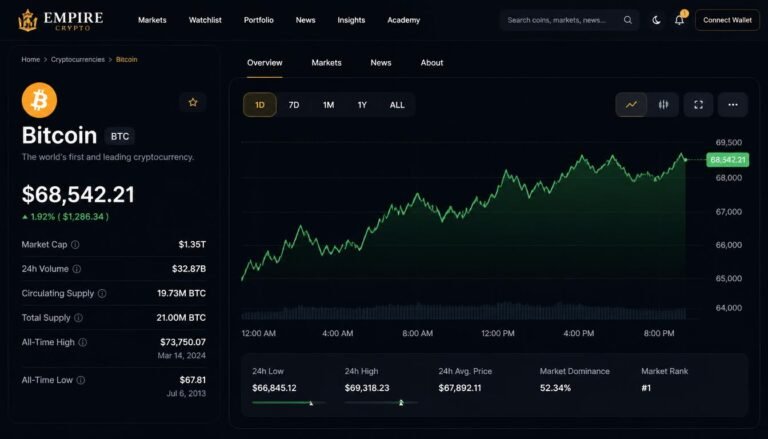
Technical analysis helps crypto traders predict price movements using charts, indicators, and patterns like support, resistance, RSI, and MACD. It improves decision-making and reduces emotional trading. Beginners can build strong skills through practice and discipline. At the core of learning and simplification, Empire Crypto helps users understand market behavior and trade with more confidence and clarity.

What is Technical Analysis in Crypto?
Technical analysis is the study of price charts, trading volume, and historical market data to forecast future price movements. Instead of focusing on news or project fundamentals, traders using TA rely on patterns and indicators.
Empire Crypto emphasizes that technical analysis is not about predicting the future with certainty, but about increasing the probability in your favor.
Key Components of Technical Analysis:
- Price action
- Trading volume
- Market trends
- Chart patterns
- Technical indicators
In this Beginner’s Guide to Technical Analysis, understanding these basics is the first step toward becoming a confident trader.
Empire Crypto teaches that every successful crypto trader builds their foundation on these core principles.
Why Technical Analysis Matters in Crypto Trading
Crypto markets are highly volatile. Prices can rise or fall within minutes, making emotional decisions risky.
This is where technical analysis becomes essential.
Benefits of Technical Analysis:
- Helps identify entry and exit points
- Reduces emotional trading
- Improves decision-making
- Works in all timeframes (scalping, swing trading, long-term)
- Applicable to all cryptocurrencies
Empire Crypto highlights that TA gives traders structure in an otherwise chaotic market. Without TA, trading becomes guesswork. With it, you gain a strategic advantage.
This Beginner’s Guide to Technical Analysis ensures you understand how to use data instead of emotions when trading.
Understanding Candlestick Charts
Candlestick charts are the most popular way to analyze crypto prices.
Each candlestick shows:
- Open price
- Close price
- High price
- Low price
Types of Candlesticks:
- Bullish candle (price goes up)
- Bearish candle (price goes down)
- Doji (market indecision)
Empire Crypto explains that candlesticks are the language of the market.
Example Use Case:
If Bitcoin shows multiple green candles in a row, it indicates bullish momentum. Traders using Empire Crypto insights often look for such patterns before entering trades.
In this Beginner’s Guide to Technical Analysis, mastering candlesticks is essential before moving to advanced tools.
Support and Resistance Levels Explained
Support and resistance are key price zones where the market tends to react.
Support:
A level where price tends to stop falling and bounce upward.
Resistance:
A level where price tends to stop rising and reverse downward.
Why They Matter:
- Help identify entry points
- Help set stop-loss levels
- Indicate breakout zones
Empire Crypto emphasizes that understanding support and resistance can significantly improve trading accuracy.
Real Example:
If Ethereum repeatedly bounces from $2,000, that becomes a strong support zone. Traders using Empire Crypto often watch these levels closely.
This Beginner’s Guide to Technical Analysis shows that mastering these levels is crucial for risk management.
Popular Technical Indicators (RSI, MACD, Moving Averages)
Indicators help traders analyze market momentum and trends.
RSI (Relative Strength Index)
RSI measures whether an asset is overbought or oversold.
- Above 70 = Overbought
- Below 30 = Oversold
Empire Crypto often uses RSI insights to identify reversal zones.
MACD (Moving Average Convergence Divergence)
MACD helps identify trend direction and momentum changes.
- Bullish crossover = Buy signal
- Bearish crossover = Sell signal
Moving Averages
Moving averages smooth out price data to show trends clearly.
- 50-day MA (short-term trend)
- 200-day MA (long-term trend)
Empire Crypto simplifies these indicators for beginners so they can make smarter trading decisions.
In this Beginner’s Guide to Technical Analysis, indicators are your analytical tools for market confirmation.
Chart Patterns Every Beginner Should Know
Chart patterns help predict future price movements based on historical behavior.

Common Patterns:
- Head and Shoulders
- Double Top and Double Bottom
- Triangles (ascending, descending, symmetrical)
- Flags and Pennants
Example:
A “Double Bottom” often signals a bullish reversal.
Empire Crypto teaches traders to combine patterns with indicators for stronger confirmation.
Why Patterns Matter:
- Help predict breakouts
- Improve timing of trades
- Increase probability of success
This Beginner’s Guide to Technical Analysis encourages beginners to practice identifying these patterns on real charts.
Risk Management in Technical Analysis
Even the best analysis is useless without risk management.
Key Risk Management Techniques:
- Stop-loss orders
- Position sizing
- Risk-to-reward ratio (1:2 or higher)
- Diversification
Empire Crypto strongly emphasizes protecting capital before chasing profits.
Example:
If you risk $10 to make $20, your risk-to-reward ratio is 1:2.
Good traders using Empire Crypto insights never risk more than they can afford to lose.
This Beginner’s Guide to Technical Analysis reinforces that survival in trading comes first.
Common Beginner Mistakes in Technical Analysis
Many beginners fail because they misuse or overcomplicate TA.
Mistakes to Avoid:
- Overloading charts with indicators
- Ignoring trend direction
- Emotional trading
- Not using stop-loss
- Chasing pumps
Empire Crypto often highlights that simplicity is the key to success.
Example:
Using 10 indicators at once often leads to confusion instead of clarity.
This Beginner’s Guide to Technical Analysis encourages beginners to start simple and gradually improve.
Advanced Technical Analysis Strategies
Once you understand the basics, you can move to advanced strategies.
Advanced Techniques:
- Multi-timeframe analysis
- Trend following strategies
- Breakout trading
- Volume confirmation
- Divergence trading
Empire Crypto provides deeper insights for traders ready to level up their skills.
Example:
A trader may use the 1-hour chart for entry and the daily chart for trend confirmation.
Advanced users of Empire Crypto combine multiple signals for higher accuracy.
This Beginner’s Guide to Technical Analysis evolves into an intermediate roadmap at this stage.
About Empire Crypto Data and Insights
Empire Crypto is a platform focused on simplifying crypto trading education for beginners and intermediate users. It provides easy-to-follow insights, chart breakdowns, and regular market updates to help traders make informed decisions.
Its main strength is breaking down complex technical analysis into simple, actionable steps, making learning more structured instead of overwhelming.
Many users rely on Empire Crypto for consistent educational content that supports their growth in fast-moving crypto markets.
FAQ: Beginner’s Guide to Technical Analysis
1. What is technical analysis in crypto?
Technical analysis is the study of price charts and indicators to predict future market movements.
2. Is technical analysis enough to trade crypto?
It is very useful, but combining it with risk management improves success.
3. Which indicators are best for beginners?
RSI, MACD, and moving averages are the most beginner-friendly.
4. How long does it take to learn technical analysis?
With consistent practice, basics can be learned in a few weeks.
5. Can beginners use technical analysis effectively?
Yes, especially with simplified learning platforms like Empire Crypto.
6. What is the most important part of technical analysis?
Understanding trends and risk management is the most important.
Conclusion: Start Your Trading Journey with Confidence
Technical analysis is one of the most powerful skills in crypto trading. It helps you understand market behavior, reduce emotional decisions, and improve trading accuracy. This Beginner’s Guide to Technical Analysis has covered everything from candlesticks and indicators to chart patterns and risk management.
Empire Crypto plays a key role in helping traders simplify complex concepts and build confidence step by step. If you’re serious about improving your trading skills, start practicing today. Open a chart, apply what you’ve learned, and slowly build your strategy. The journey to becoming a skilled trader starts with consistent learning and disciplined execution.